

Can “hustle ball” win in the playoffs?
Love ‘em or hate ‘em, Detroit has figured out how to score at a high level without making threes this year. But will it hold up in the playoffs?
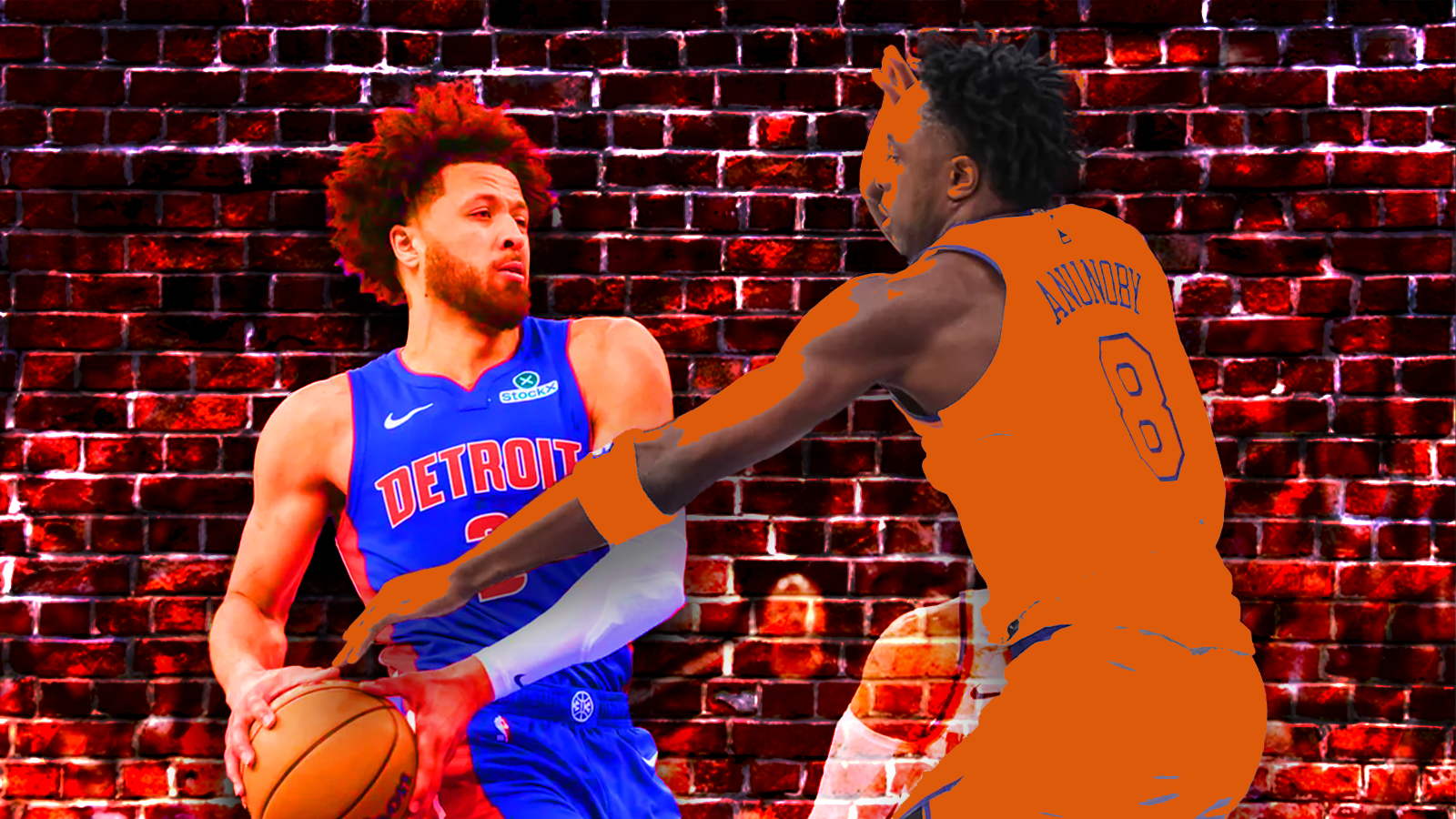
This is a piece about the Pistons, and the Knicks. HOWEVER, it’s not really about the Pistons versus the Knicks. Sorry to disappoint you! With the Knicks getting back on track lately after another annoying loss to the Pistons, it is completely fair if you are thinking more about which teams they may match up well – or poorly – against in the playoffs. No, this is more an examination of some of the trends sweeping the league this year, as exemplified by the Motor City Cades, in order to make sense of things for the entire league as we approach the playoffs.
The Question: Can MAX EFFORT ball win in the playoffs?
A few weeks ago, I had a question after watching a random Pistons game: while I enjoy watching Cade spam real-hooper ball as much as the next man, the Pistons’ offense – especially in the half court – did not seem particularly amazing to me. They’re terrible at shooting threes, and don’t have many shot creators. Yet they have sat in the top five offenses statistically for months. What gives? There will be some statistical exploration later, but it became clear to me that the Pistons offense thrives because of a few factors: being a dominant offensive rebounding team, using their athleticism to get in transition a ton, and drawing free throws as much as possible. Maximizing those three types of scoring has basically allowed them to be super efficient, even while not having much shot creation and while being bad at shooting threes, which is kind of nuts if you think about it.
This begs the more important question: will this new analytically-driven, grifty style of hoops work in the playoffs? Will other teams who feature similar strategies – Boston hitting the glass like crazy and chucking up a million threes, Houston lapping the field in offensive rebounding – find success in the playoffs?
Anecdotally, “max effort” regular season advantages like running SUPER HARD on makes and misses, or hitting the glass with INTENSITY AND VIGOR, have diminishing returns in the playoffs. In theory, during the playoffs most teams are putting forth great effort (running harder, boxing out more, etc). Similarly, playing to draw free throws also seems to be a shaky playoff strategy (James Harden says hello). Hell, the Pacers and Thunder were not particularly good offensive rebounding teams last year, and while the Thunder were turnover generating monsters, the Pacers just beat teams by scoring and shooting efficiently everywhere, all the time, the old fashioned way.
To me, this is the defining question of this upcoming playoffs. Offensive rebounding involves skill, as does drawing fouls and getting out in transition… but in theory playoff teams dial up the boxing out and transition defense, and we know playoff refs swallow whistles more. So will this work for teams like the Pistons, and to a lesser extent the Knicks, Rockets, and a few others?
Context: When did teams start doing this?
Let’s back up a bit. Context first. In prior seasons, a few teams have leaned into offensive rebounding as a major weapon - for example, the Julius/Thibs Knicks, who led the league in offensive rebound percentage (OREB%) in 2023-24 at 33.4%. In 2025-26, that number would have the Knicks just outside the top five. In 2023-24, three teams exceeded an OREB% of 32%, while this year eight teams have exceeded that. Offensive rebounding has been the latest analytics frontier to catch fire around the league.
It’s part of a wider trend toward what is called “winning the possession battle” - if you can shoot more shots than your opponent, even if you are a bit less efficient, you can still beat them. If you and I play one-on-one, every bucket worth 2 points to 12 and I go 6-14, and you go 5-8, I win. Maybe it’s because I hit the offensive glass like the Pistons or Knicks, two of the top OREB% teams, or maybe it’s because I generated a bunch of turnovers like the champion Thunder, who lapped the field in turnover generation during the playoffs last season. Not coincidentally, the top two teams in turnover generation this season are the Thunder again, and the aforementioned Pistons, whose defense has dialed up aggression to a new level this season.
Offensive rebounds, as we know from watching Mitch grab them and kick them out to open shooters, or from watching Detroit grab them up for more rim attempts, can lead to high efficiency buckets. Similarly, blocks and steals can lead to transition buckets. Transition is one of the most efficient playtypes for teams with skilled finishers like the Knicks (Mikal is one of the best transition hoopers in the league), as well as teams of monster athletes like the Pistons (who are third in the league in fast break points, behind Dallas and Toronto, two offenses who are not good despite running often). Those three teams don’t only run off turnovers, but off of makes and misses. Dallas upset the Knicks embarrassingly earlier this season by putting up almost 30 fast break points in the first half, en route to almost 80 points in two quarters. Josh Hart himself has transitioned opponents to death. It can work.
And fouls? I’m not going to spend a lot of time talking about why drawing a ton of free throws is effective. They are easy points, easier to come by now than ever before. In 2025-26, more and more players are leaning into the strategy of barreling into defenders in hopes of drawing a whistle. It has worked, and foul calls are up like the Dow. Last season, three teams derived over 16% of their points from free throws. This year, that number is NINETEEN TEAMS. (The Knicks draw only 14.5% of their points from the line, in case you’re wondering, mostly due to the wild rim rambles of Karl-Anthony Towns.)
Who has the most “HUSTLE” points?
Fellow Strickland contributor and frequent Prez-piece-tag-teamer Doug, AKA Scooter Toots has helpfully pulled the data to answer the question: which teams have leaned the most into this? You can call it MAX EFFORT ball, HUSTLE points, or Pistons-ball, but what I mean is the combination of points from free throws, points from fast breaks, and points from offensive rebounds. Unsurprisingly, the Pistons lead the league by a fair bit, which explains why their offense (at least during the regular season!) remained elite despite halfcourt sets and scoring and shooting that make me want to pour acid into my eyes sometimes. This data was taken at the All-Star Break:
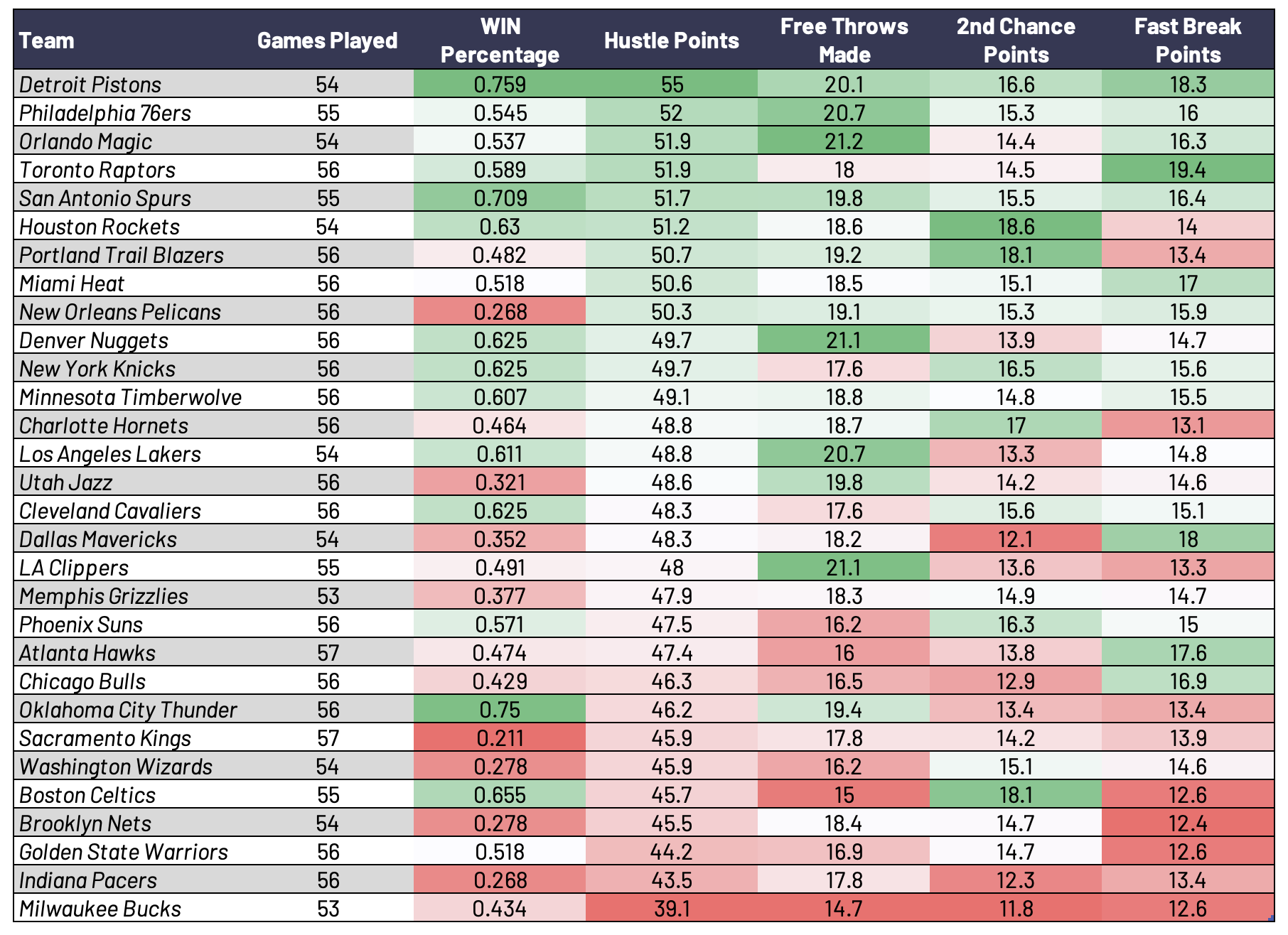
The data is sorted by HUSTLE points per game, not percentage of offense. You can see the top 10 features a mix of both good and bad teams. The top playoff teams are scattered about the chart – teams like the Celtics and Thunder specialize in only one category. The Rockets and Knicks and Nuggets are only good at one, and the Spurs, Wolves and Pistons excel at all three. All of these things are on some level divorced from traditional efficient playoff offense – being able to knock down both open and contested shots, getting high value possessions in the half court either via star creation or ball movement, etc.
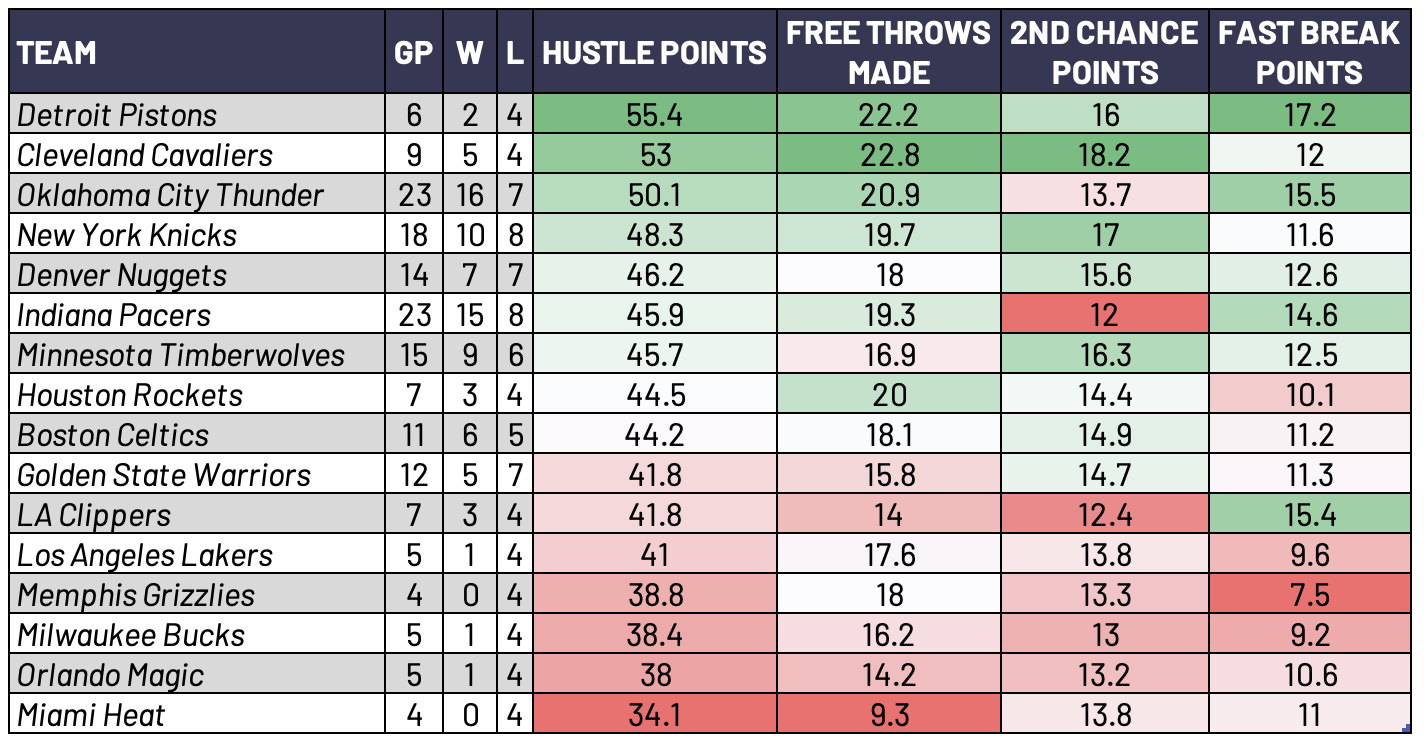
For the curious, here is the same chart for last year’s playoffs:
WTF does this all mean?
Enough fucking pontificating. I don’t know what it means. But, we will find out in the playoffs. The Pistons have basically discovered a statistically efficient means of scoring that renders 3-point shooting irrelevant, which is kind of incredible. Will it hold up? The Pistons and Cavs last year both excelled in all three areas and made quick playoff exits, but the Pistons are pushing the formula even further this year. A quick glance at these categories – free throw rate, fast break points, second chance points – for last year’s playoff teams compared to the regular season doesn’t yield much helpful information. For some teams, they ran less, for some they ran more. Free throw rate similarly was up and down. Past studies (I could only find pre-2025) showed that refs in the playoffs did not in fact tend to “let teams play”... but the NBA universe changes with enough speed that such a study is likely irrelevant now. As I mentioned, players are grifting more and defenses are daring refs to call every foul more than ever before.
We will either see it work, or we will see that this style has diminishing returns when teams lock in and scheme up. We may even see firsthand, should the Knicks get matched up with Detroit. I for one, would like to see it.
