

Are the newest Knicks just what the team needed?
It’s official. Jordan Clarkson and Guerschon Yabusele are now New York Knickerbockers! The vibes are going to be stronger than ever in the World’s Most Famous Arena. Rounding out the Knicks’ bench with these two veterans is definitely the plan for Leon Rose & Co., with a projected bench rotation of Deuce McBride, one of either Josh Hart or Mitchell Robinson (probably Hart), and then both Clarkson and Yabusele. Or maybe one or two or three of the second-year players crack the rotation. Who knows! But that’s not what we’re here to talk about. We’re here to talk about the newly-acquired Knicks.
As I like to do whenever New York brings in a new player via free agency, I whipped up some scatter plots. Graphs, if you will. Five to be exact. Welcome back to a Strickland original series: Five Graphs.
The Drivers and the Kickers
I think it’s safe to say that the Knicks’ biggest weakness last season and the season before was Jalen Brunson being the only guard who could get to the rim, AKA dribble penetration. For the veteran’s minimum, Jordan Clarkson does a pretty good job addressing this weakness.
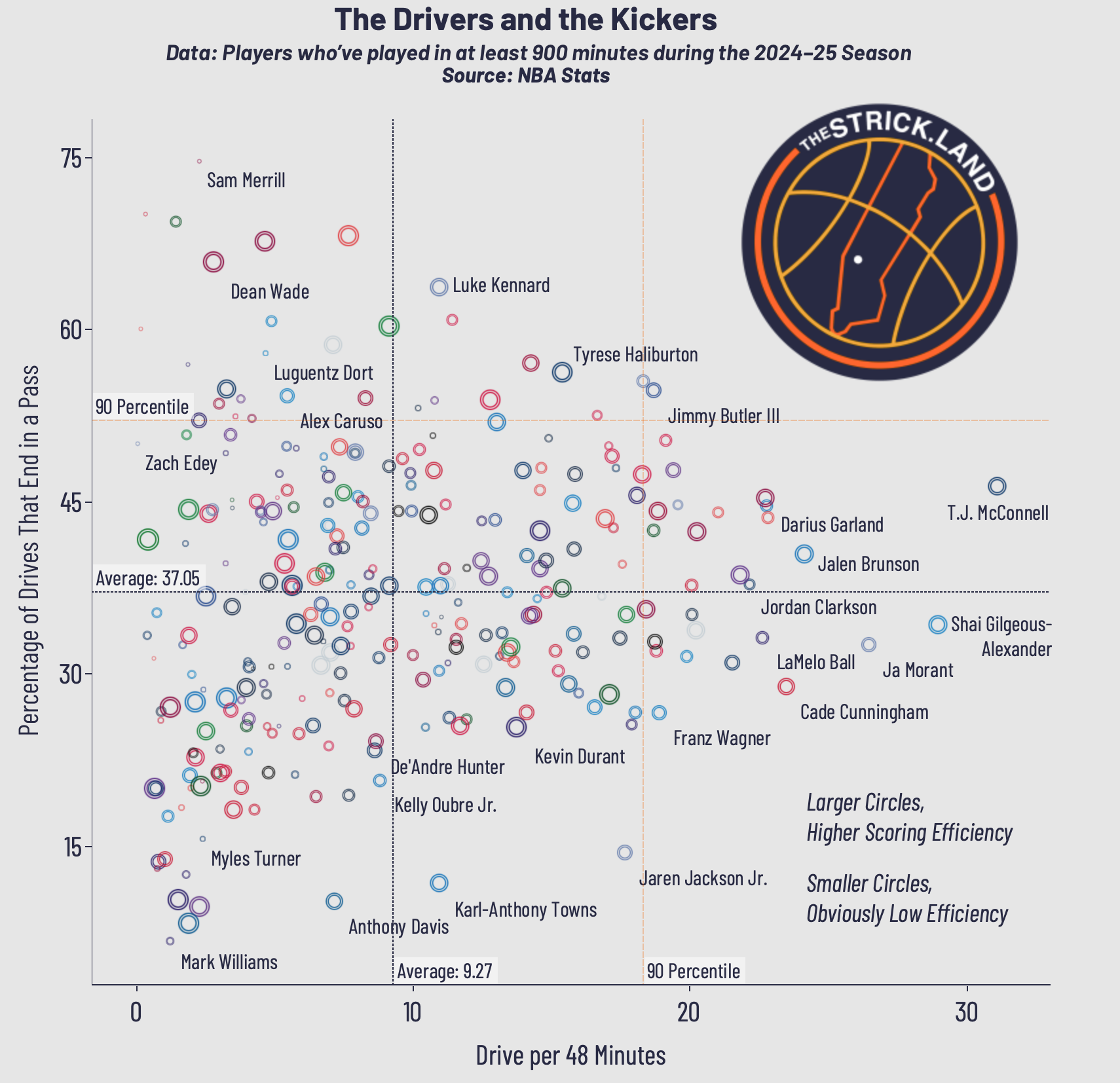
Oh hey, look at that. Jordan Clarkson is right below Jalen Brunson on the plot! I know that 900-minute figure is rather random, but Clarkson only played a total of 962 total minutes in 37 games last season. Clarkson ranks 10th in the NBA in drives per 48 minutes, averaging 22.15 drives. Brunson is fourth on this list at 24.1 drives per 48, behind T.J. McConnell (31.1), Shai Gilgeous-Alexander (28.95), and Ja Morant (26.5), in case anyone was curious.
What I think is more interesting is that despite Clarkson’s reputation as a chucker, he passed out of his drives 37.8 percent of the time, which is in the same territory of the likes of James Harden (37.7), DeMar DeRozan (38.4), and Luka Donic (38.6). Despite having a career assist percentage of 17.4 and being stuck in Basketball Hell for the past six-and-a-half years, Clarkson averaged over 20 percent in assist percentage each of the past three seasons with 2023–24 being a career year at 24.6%. Yes, he’s still a stereotypical bucket getter who may not actually be efficient (foreshadowing), but Clarkson does pass the ball more than his reputation suggests.
Shooter Gonna Shoot?
I’m gonna keep it the buck stops here with you guys. Clarkson is not an efficient shooter in the slightest.
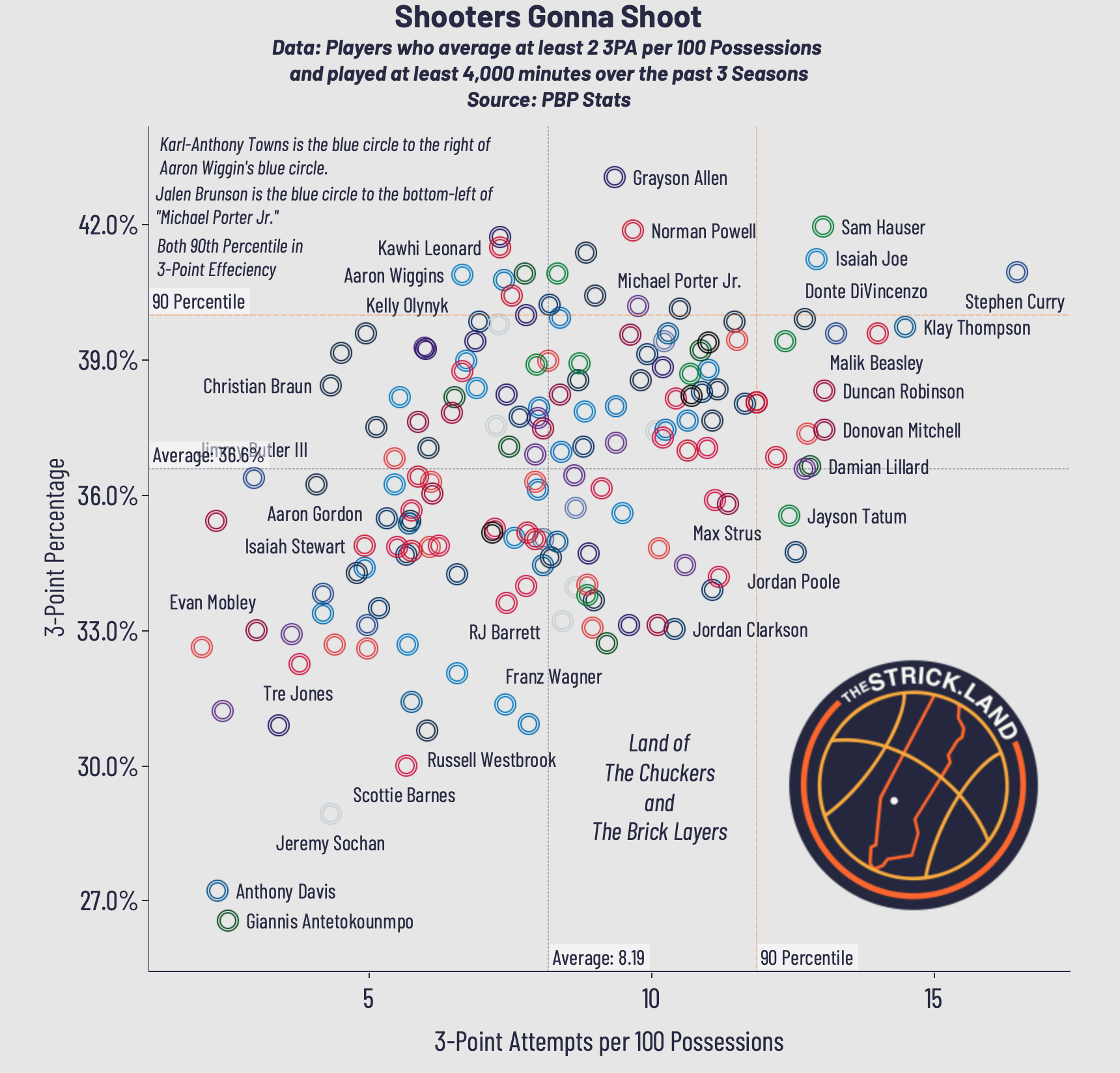
This time I took a three-year sample of 3-point shooting to account for all that “variation” that happens around the league.
A quick tangent, sorry in advance. You know what really grinds my gears? Simply reducing game outcomes to “shooting variation.” Big time box score watcher vibes. Look, variation is very much a real thing in statistics, especially with 3-point shooting. I’m not saying “shooting variation” is never a reason why a team wins or loses, but you must be watching the game to rule out other possibilities since not every shot attempt is the same.
If I were to have mapped the 80th percentile instead of the 90th percentile — another tangent: are the Celtics still looking to dump salary and should the Knicks buy property on Hauser Isle? I don’t like praising anything from Boston, but, I mean he’s in Steph Curry’s Quadrant — that’s where Clarkson would be along the 3-point attempts per 100 possessions line. Clarkson gets up 3-point shots, 10.4 3PA per 100 to be exact. That’s Trae Young (10.2) and Cameron Payne (10.4) territory. Thirty-three percent is just not good. I’ll frame it this way as well: Clarkson is like if Cam Thomas, 36.3% on 9.4 3PA per 100, took and missed one more shot every game.
The Lost Art of Boxing Out
Let’s jump right into our guy Guerschon Yabusele, because he’s the type of front court player this team was missing off the bench. Standing in at 6-foot-8, 270 pounds, and a caboose Phil Jackson would be proud of, Yabusele might not have the volume to be in the upper rebounding echelons, but he certainly is a plus at rebounding.

Above average in the contested rebounding stats while having similar box-outs-per-48-minute figures to Rudy Gobert (3.0), Mark Williams (3.0), and Anthony Davis (2.7) is certainly not going to take away from the rebounding advantage the Knicks have in the league. Yabusele averaged 2.9 box outs per 48 minutes with 37.2 percent of his 5.6 rebounds per game (equals 2.1) being contested rebounds. It’s what Isaiah Stewert averaged last season, for some context, though it’s also important to note that Stewart averaged seven minutes per game less than Yabusele and averaged one more box out per 48 minutes. Does this make Yabusele MLE Beef Stew?
The Moreyballers
What really makes this Yabusele signing a great deal is that he’s what I like to call a “Moreyballer,” meaning he’s taking only shots at the rim and behind the 3-point line. Not only does he have the volume, Yabusele also has the efficiency to make him a very valuable player off the bench.
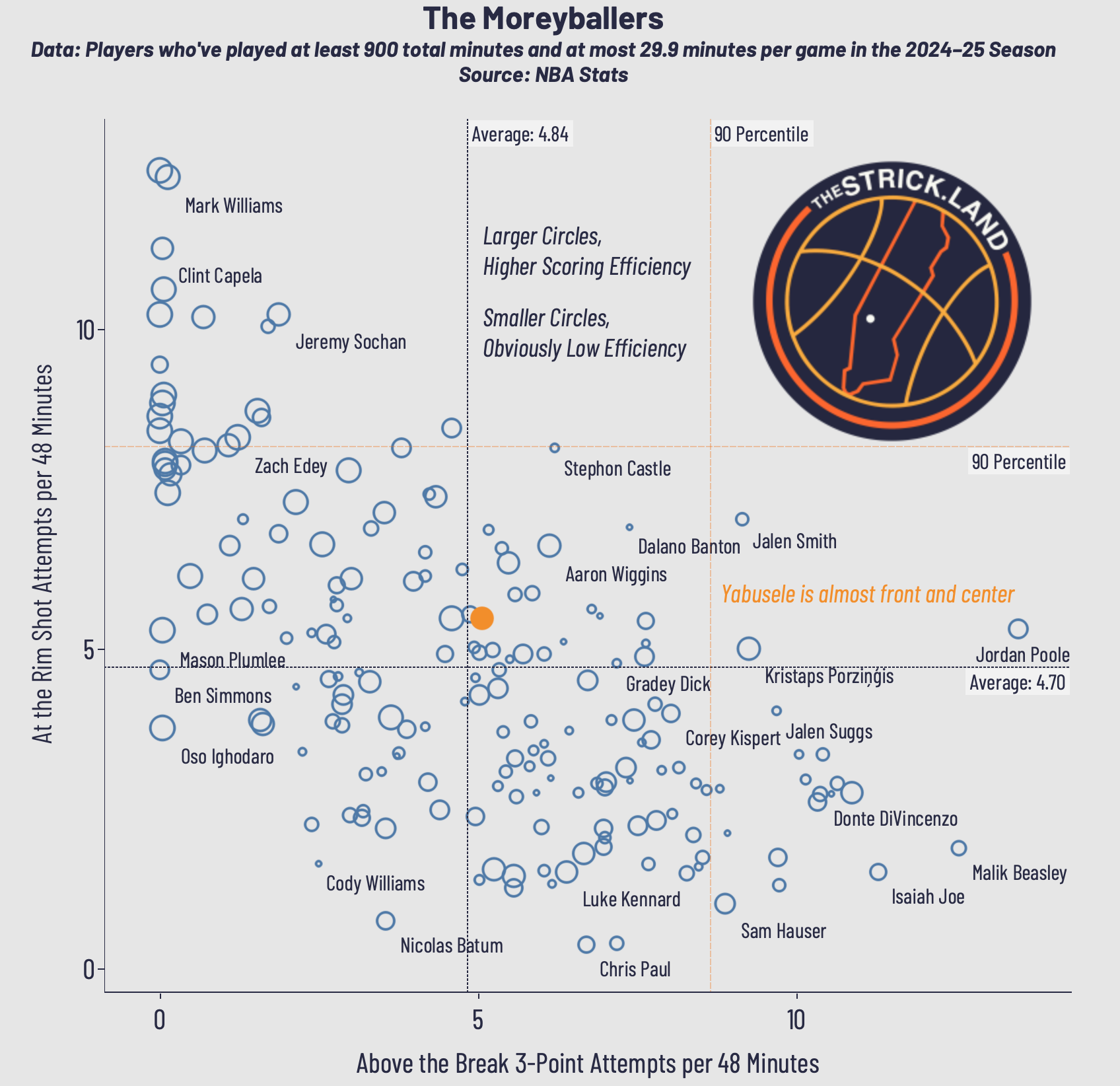
Here is a nice little cherry-picked gem of a stat. Last season there were 52 players in the NBA that took at least 200 shots in the restricted area and 200 shots from above the break. See, we are talking about niche qualifications here. There were only five players more efficient at scoring than Yabusele (1.31 points per shot attempt) in these two Moreyball zones: Nikola Jokic (1.38), Zach Lavine (1.34), Pascal Siakam (1.34), Lebron James (1.32), and Karl-Anthony Towns (1.32). If he can more or less do what he did last year in Philadelphia – but playing on a team that actually wins games and has a real point guard-center combo that makes it past the second round – Yabusele should be an analytics darling again.
Shot Charts and Final Thoughts
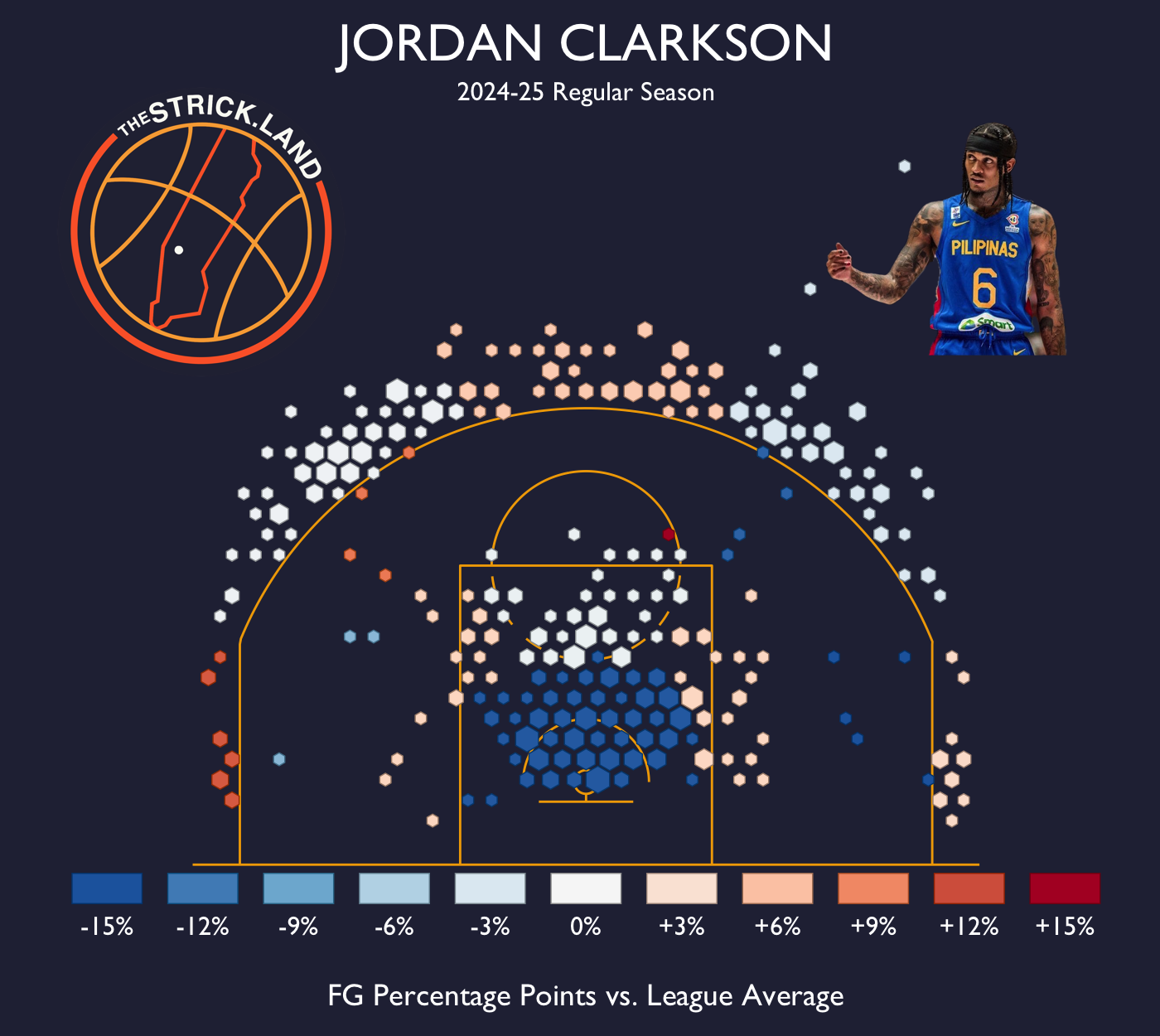
You know the title of this is “Five Graphs?” There’s an assumption that there will be five and only five graphs in this article. Well, like every politician outside of Zohran Mamdani, I lied. There are actually six graphs in this “Five Graphs” article. Because there are two official free agent signings, that means I had to make two shot charts. Here’s Clarkson’s:
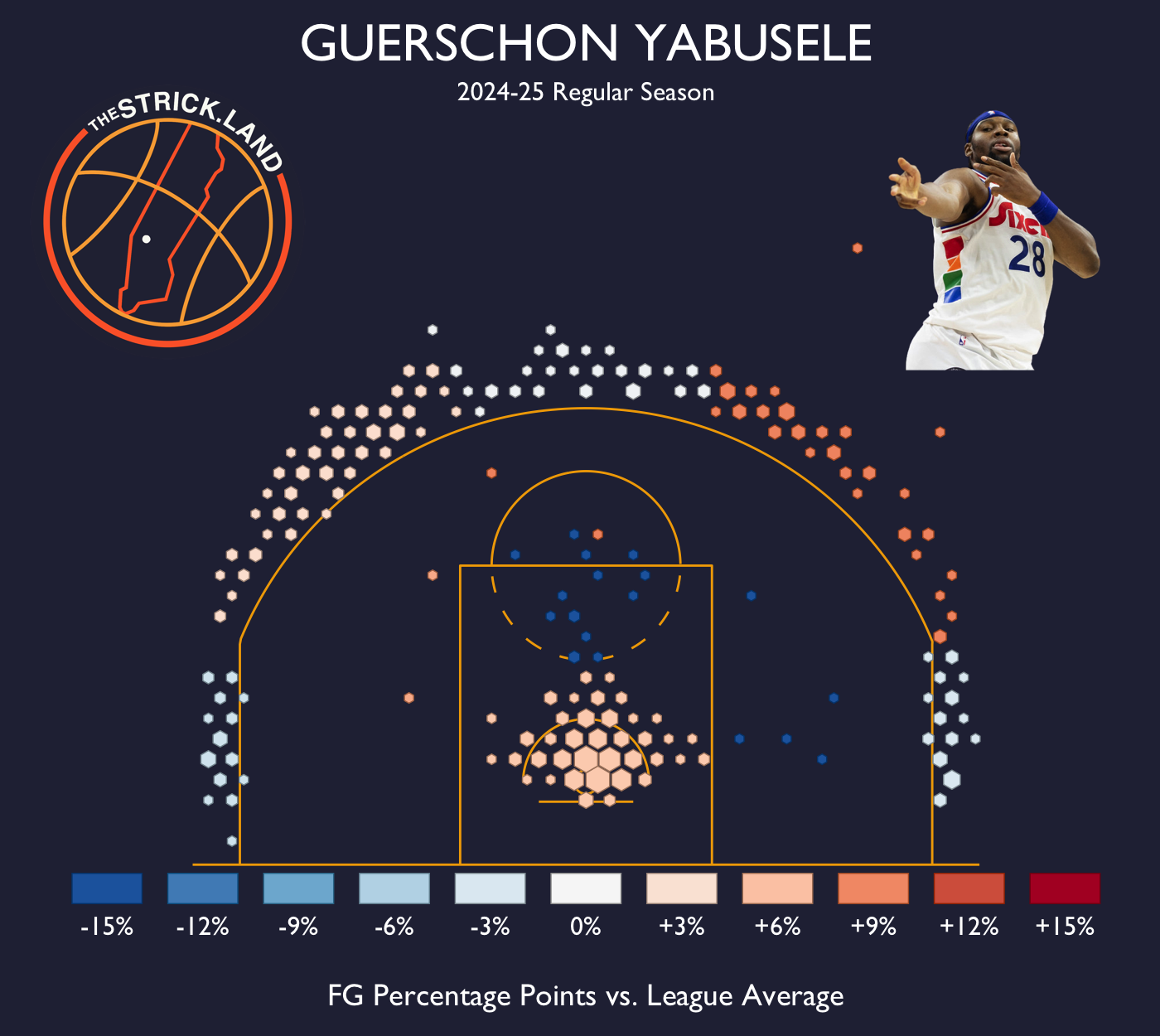
And here is Yabusele’s:
Clarkson might be ice cold at the rim, but there were two pockets of above-league-average efficiency from the left corner and straight above the arc. You can also look at this shot chart and his Basketball-Reference page to come to a “Clarkson is cooked” conclusion.Did I mention he’s 33 years old coming off a plantar fasciitis surgery? He signed with the Knicks at the veteran’s minimum and has been lost in translation in Salt Lake City. I have a feeling Clarkson is going to have moments at The Garden and the vibes will be immaculate. This will be the better version of the Cam Payne dice roll of last year.
Yabusele’s shot chart, on the contrary, is really almost the platonic ideal of Moreyball. Being a legitimate threat from behind the arc and off the dribble playing either the four or the five on this Knicks team is going to do wonders. It would be like if Precious Achiuwa could shoot and dribble. The last time the Knicks had a Moreyball forward, Obi Toppin was catching lobs from Immanuel Quickley. Toppin and Yabusele certainly aren’t the same type of player, but they both fit that bench forward archetype that allows you to play a different style of play. You can play him with Towns to maintain a size advantage lineup without sacrificing spacing. You can play small with Yabusele at the five along with both Josh Hart and OG Anunoby on the wings so you have a more switch-focused defense without taking a big rebounding hit.
Yabusele can make open shots and drive to the rim, meaning he cannot be ignored on offense like Precious was most of the time. If the annoying Bad Josh Hart appears in a game, you can play Yabusele with Anunoby and Towns to have a five-out look. Outside of Al Horford, who will probably end up making more money than Yabusele did with New York, I feel like it’s safe to say that Guerchon was the best player to fit this spacing-big role. That doesn’t make me a homer, right?
