

Inside how the Knicks made history vs. the Cavs in Game 1 of the Eastern Conference Finals
What buttons did Mike Brown push to get the Knicks in a position to make history?
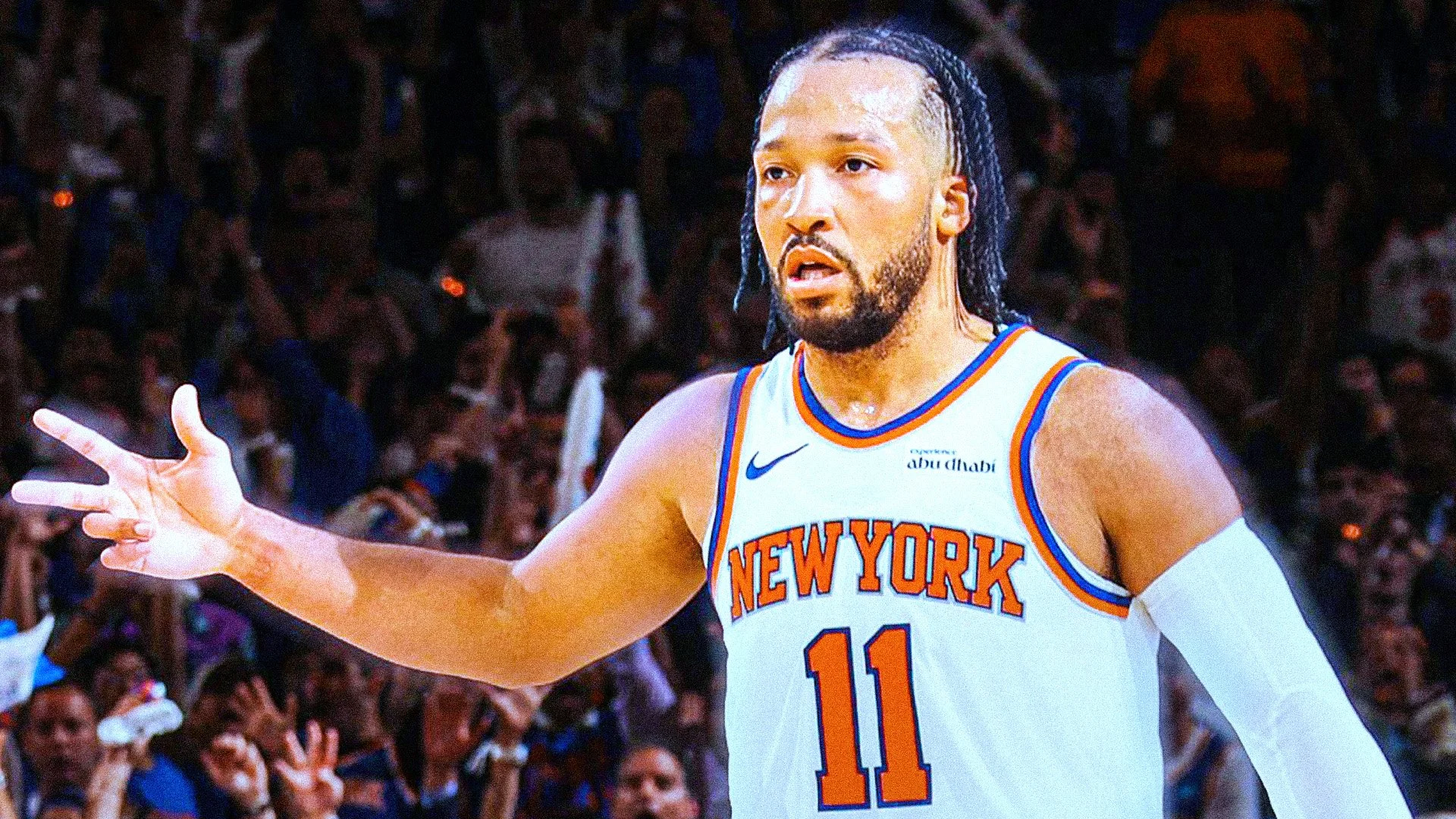
The Knicks looked dead in the water, poised to lose Game 1 of the Eastern Conference Finals to the Cavs on their home court. But then Jalen Brunson wrote another chapter to his story at Madison Square Garden.
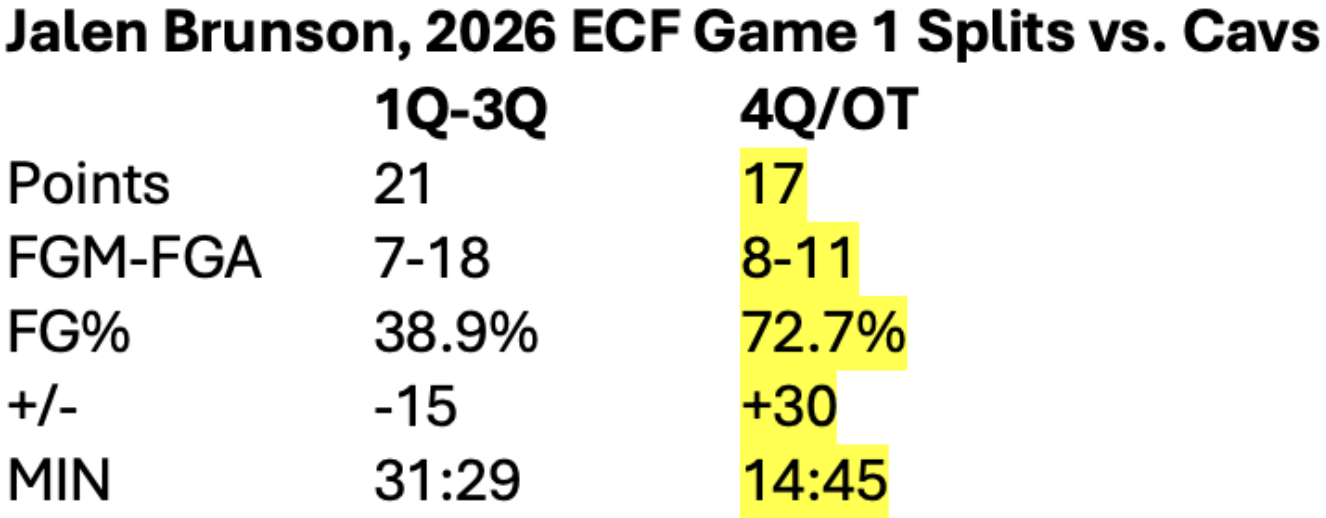
Brunson struggled through three quarters vs. the Cavs in Game 1, registering 21 points on 18 shots (38.9% shooting) and was a minus-15 in his 31-plus minutes. Then, he flipped the switch in the fourth quarter, scoring 17 points on 11 shots (72.7% shooting) and was a plus-30 in his 14 minutes and 45 seconds of play to end the game.
"We got some stops. We kept fighting and believing. We just kept chipping away,” Brunson said on ESPN after the game concluded. “They were playing great basketball. We just found a way. I really don’t have an answer."
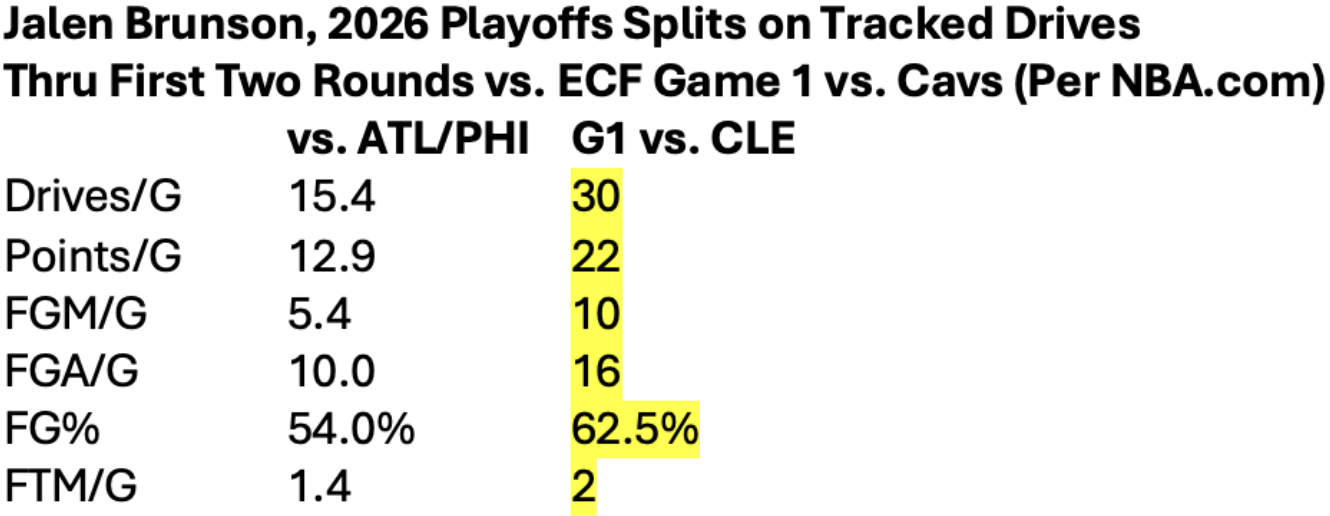
Brunson was heavily relying on drives to the basket in the series opener against the Cavs, as he had 30 drives that netted 22 points on 10-16 shooting (62.5%) with two free throws made off those drives. Through his first 10 games of the 2026 playoffs, Brunson averaged 15.4 drives per game — that was fourth in the NBA prior to Game 1 among players with at least eight games played — scoring 12.9 points per game on those on 54% shooting.
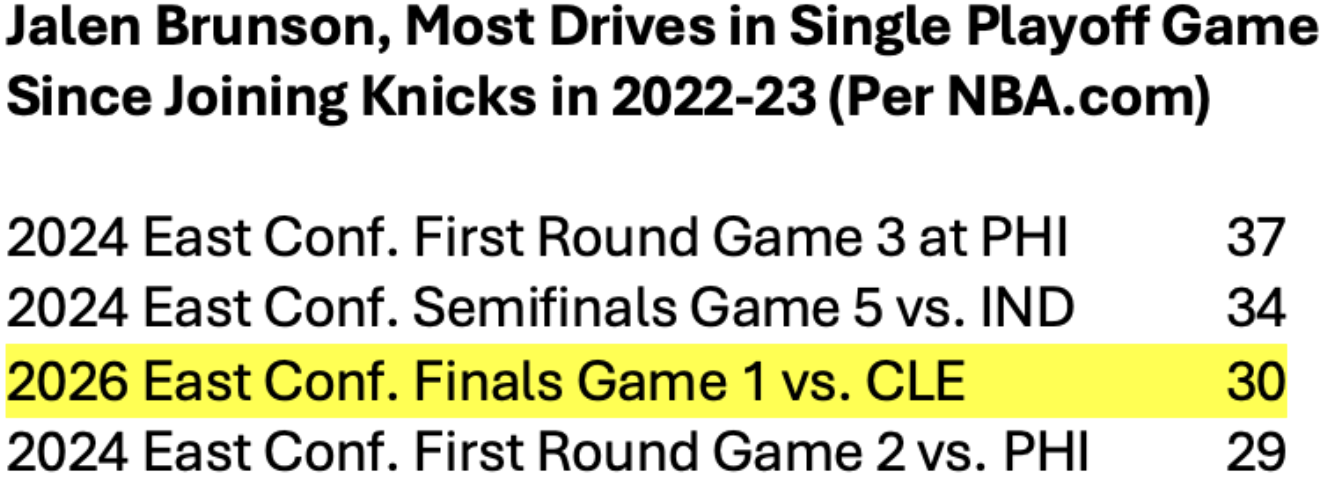
It was the third-most drives in a single playoff game from Brunson since he joined the Knicks ahead of the 2022-23 season. The only playoff games since joining the Knicks where Brunson had more drives were Game 3 of the first round against the Sixers in 2024 (37) and Game 5 of the second round against the Pacers in 2024 (34).
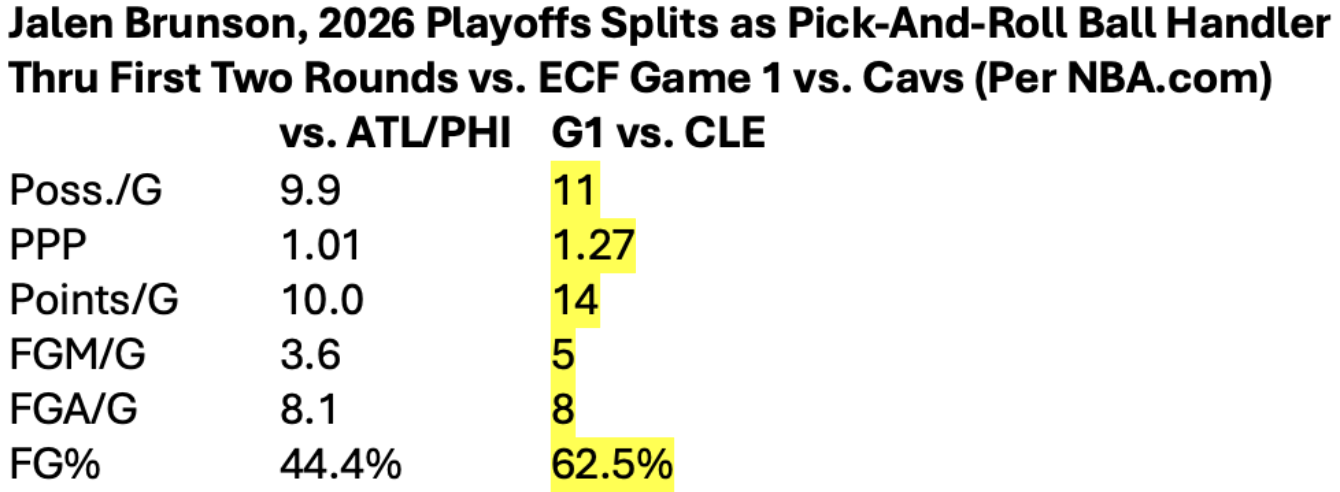
Brunson was also feasting for the Knicks in the pick-and-roll game in Game 1 vs. the Cavs, scoring 1.27 points per possession (PPP) as the pick-and-roll ball handler to open the series. He entered the series scoring 1.01 PPP through his first 10 playoff games in 2026.
FYI: the league-wide average during the 2026 postseason as a pick-and-roll ball handler is 0.86 PPP on 41.5% shooting. If you remove Brunson from the equation, the Knicks have still been above-average with 0.96 PPP in non-Brunson P&R ball-handling possessions.
One of the keys to Brunson’s brilliance taking center stage down the stretch for the Knicks was him and the Knicks’ offense relentlessly targeting 36-year-old James Harden. In the fourth quarter and overtime periods, the Knicks shot 11-16 (68.8%) from the field when Harden was tracked as guarding the shooter in Game 1.
For the whole game, the Knicks had a 1.74 PPP (33 points) across 19 partial possessions when Harden was guarding Brunson. Mike Brown wasn’t exactly shy about the admitting the Knicks were targeting him.
According to the ALL NBA Podcast, “James Harden was the screener defender on 21 on-ball picks in the fourth quarter and OT alone... the Knicks got 1.6 points per direct action on those plays.”
Zach Kram of ESPN noted that the Knicks had targeted Harden with 27 picks — the most picks he’s ever defended in a single game in the tracking era — as they scored 1.53 points per pick that “led directly to a shot, foul, or shot one pass away.”
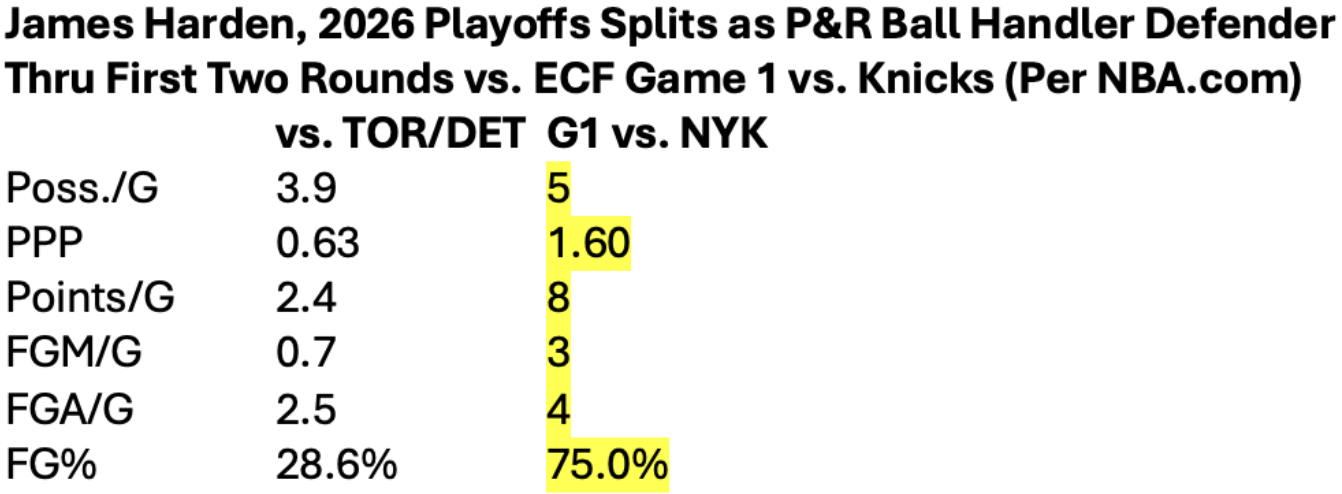
Harden was tracked as the pick-and-roll ball handler defender specifically on five possessions in Game 1 vs. the Knicks. The Knicks scored eight points on 3-4 (75%) shooting, mustering 1.60 PPP on those possessions.
The ALL NBA Podcast also notes on Twitter that the Knicks “got Harden to switch into nine isolations in the fourth quarter and OT, getting an obscene 1.9(!!) points per direct action.”
The Knicks’ staggering 1.88 points per direct action in the fourth quarter with Harden guarding the ball handler is the most since the 2013-14 season for any defender who had to guard at least eight actions in a single quarter, according to The ALL NBA Podcast.
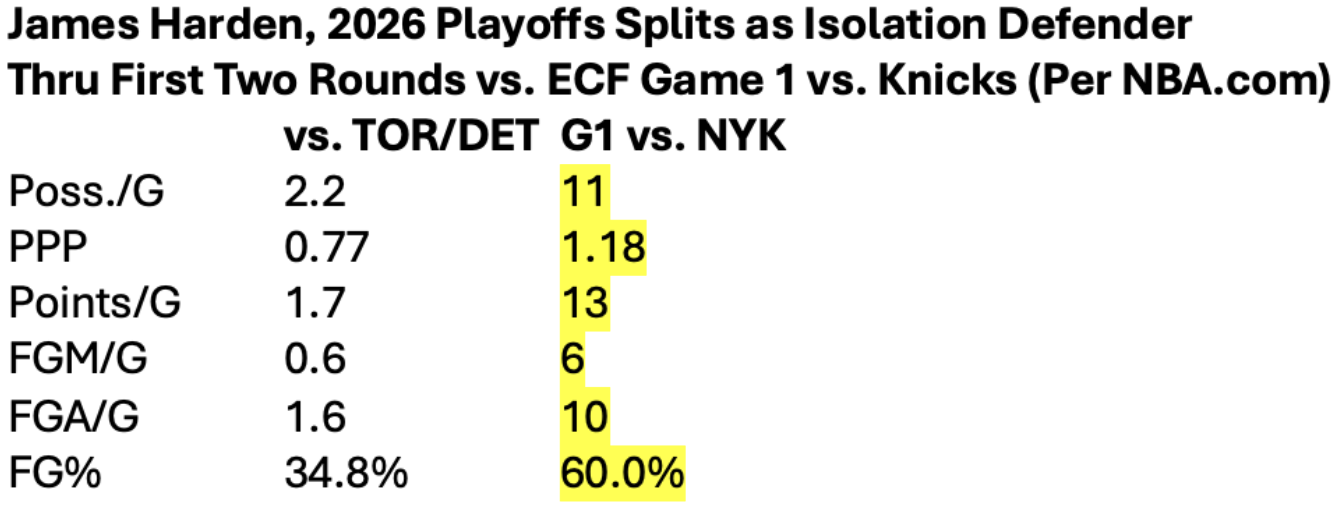
Overall, Harden was tracked as the isolation defender in 11 possessions in Game 1 vs. the Knicks. The Knicks scored 13 points on 6-10 shooting (60%)... that’s 1.18 PPP. Harden had entered the series averaging just 2.2 isolation possessions per game as a defender.
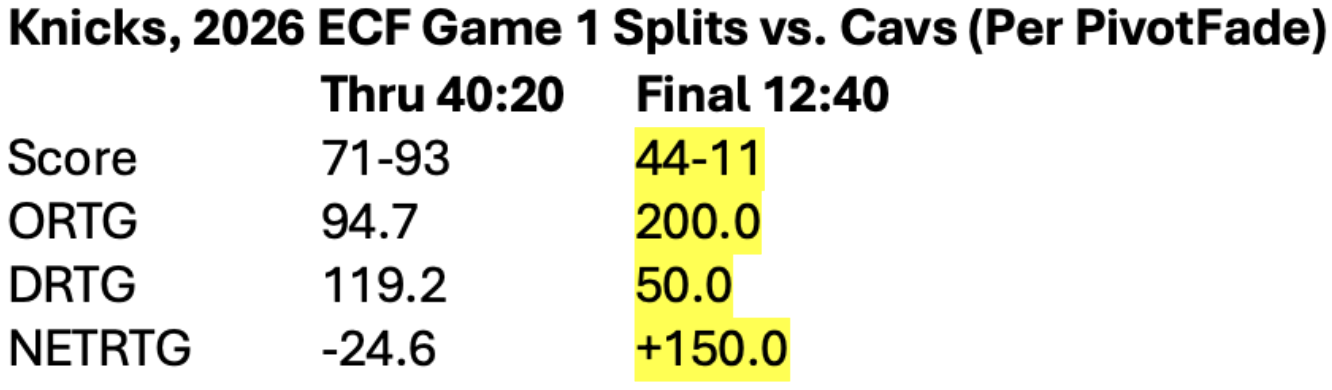
The Knicks looked lost on both sides on the ball through the first three quarters and the first four minutes and 20 seconds of the fourth quarter. They were outscored by 22 points in that span, posting just a 94.7 offensive rating (ORTG) with a 119.2 defensive rating (DRTG) and -24.6 net rating (NETRTG).
However, they became a juggernaut on both ends in the final 12 minutes and 40 seconds of the game — which includes the five-minute overtime period. The Knicks outscored the Cavs 44-11 to end the game, posting a 200 ORTG, 50 DRTG, and +150 NETRTG.
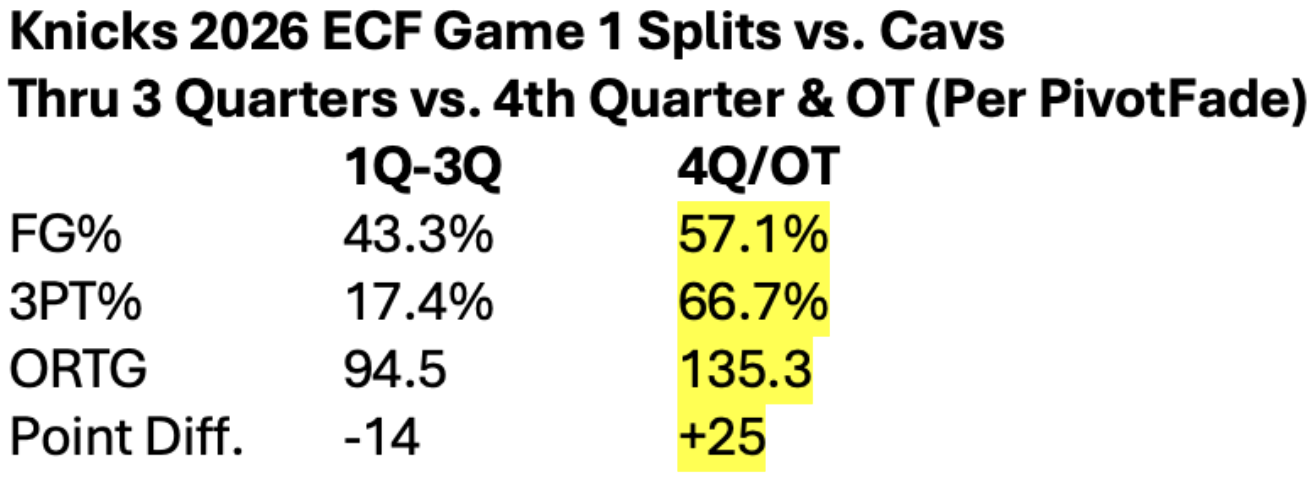
The Knicks were finally making shots and made the Cavs pay for not completely knocking them out of this game. The Knicks shot 57.1% from the field and 66.7% from three in the fourth quarter and overtime, posting a 135.3 ORTG and outscoring the Cavs by 25 points. Through the first three quarters, they had shot just 43.3% from the field and 17.4% from three, putting up a 94.5 ORTG en route to getting outscored by 14 points.
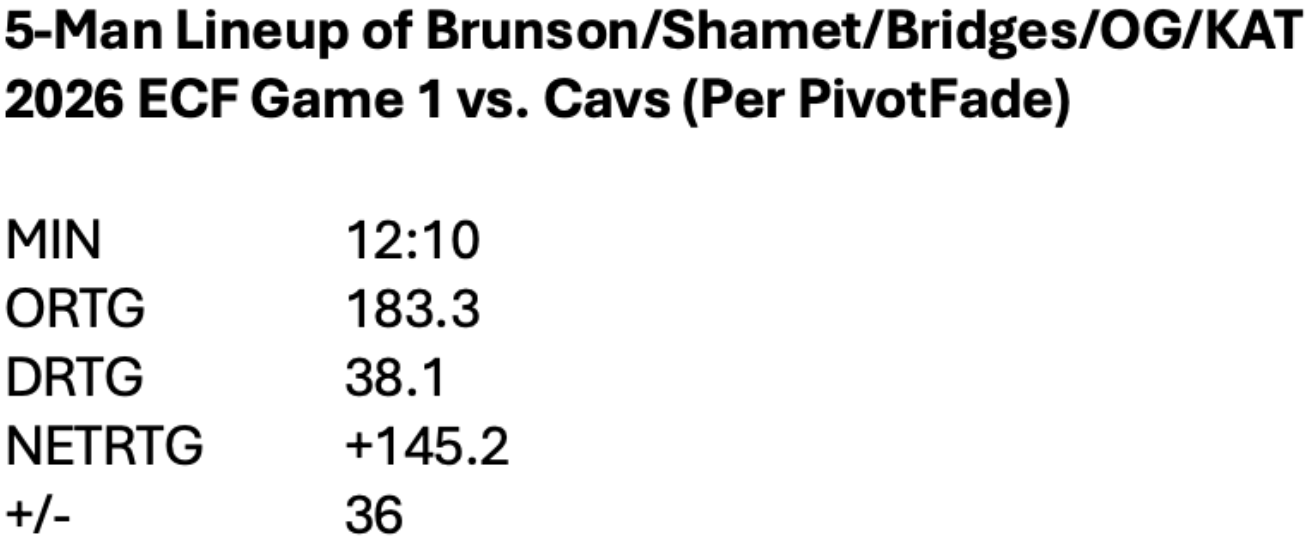
The Knicks decided to go with a five-man lineup of Brunson, Landry Shamet, Mikal Bridges, OG Anunoby, and Karl-Anthony Towns for the first time all game with 7:52 left in regulation. That lineup played all but 42 seconds the rest of the way... and they demolished the Cavs in those 12 minutes and 10 seconds of play together.
The decision to go with Shamet over Hart allowed the Knicks to play a true five-out offense, opening up the floor for Brunson (and others) to operate in a more efficient manner through the end of the game.
They scored 44 points on 24 offensive possessions (1.83 PPP), posting a 90.2% true shooting percentage (TS%). They held the Cavs to score eight points (0.38 PPP) during those minutes.
It was the same five-man lineup that they started the game with, except for Hart. The Knicks were minus-23 with a 72.1 ORTG in his 30 minutes and 30 seconds of play. In the 22 minutes and 30 seconds with him off the floor in Game 1, the Knicks had a 154.3 ORTG and were plus-34.
Hart ended up only playing in only two minutes and 43 seconds in the fourth quarter and overtime. After the switch to the five-man starting lineup without Hart, he only played in 42 seconds — exclusively for defensive purposes.
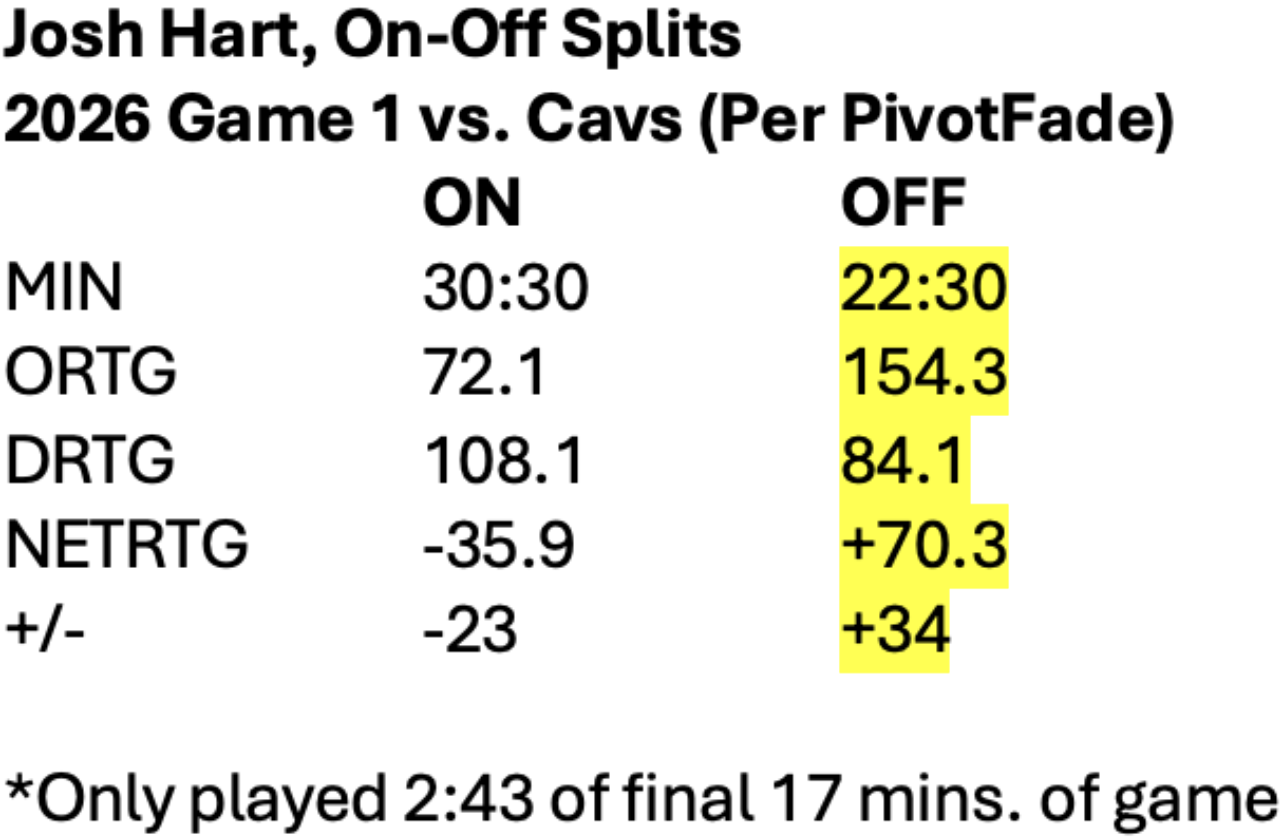
Most specifically with Hart, so much more was opened up for the Knicks on offense with him off the floor, as Caitlin Cooper of Basketball, She Wrote alluded to on Twitter.
Also, quickly... a huge shout-out to Shamet.
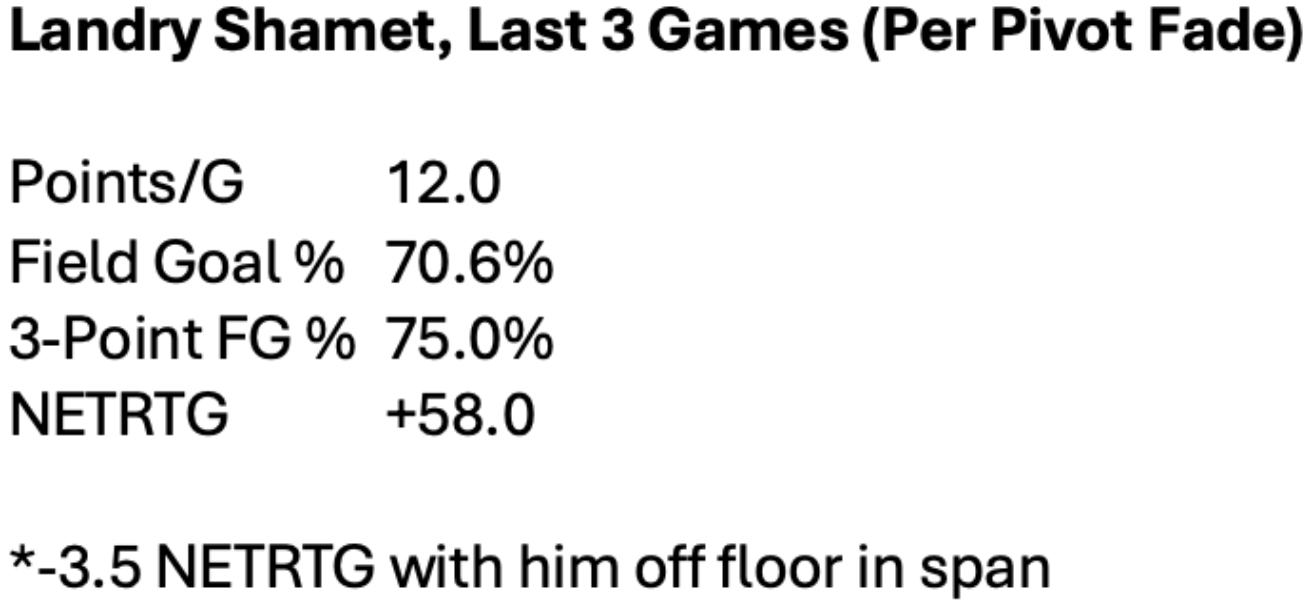
The eight-year veteran was mostly out of the rotation for a five-game stretch before Anunoby’s hamstring injury. Over his last three games, he’s averaging 12 points per game on 70.6% shooting from the field and 75% from three (four attempts per game). In that three-game span, the Knicks have a 139.3 ORTG, 81.3 DRTG, and +58 NETRTG in his 55 minutes on the floor, opposed to a 116.6 ORTG, 120.1 DRTG, and -3.5 NETRTG in the 94 minutes in that span with him sitting.
Also, very importantly, Shamet was excellent on defense during the Knicks’ comeback run. He completely turned off Donovan Mitchell’s water during the fourth quarter and overtime periods. Mitchell didn’t score a single point while guarded by Shamet — the Cavs had 0.81 PPP (18 points) in 22.3 possessions where he guarded Mitchell.
Shamet disrupting on the defensive side has been a common theme this postseason.
He’s held opponents to 12-49 (24.5%) from the field in the 2026 playoffs, and that’s the lowest defensive FG% (DFG%) by any player to defend at least 40 shots this postseason. For reference: Ausar Thompson held opponents to a 35.5% DFG%.
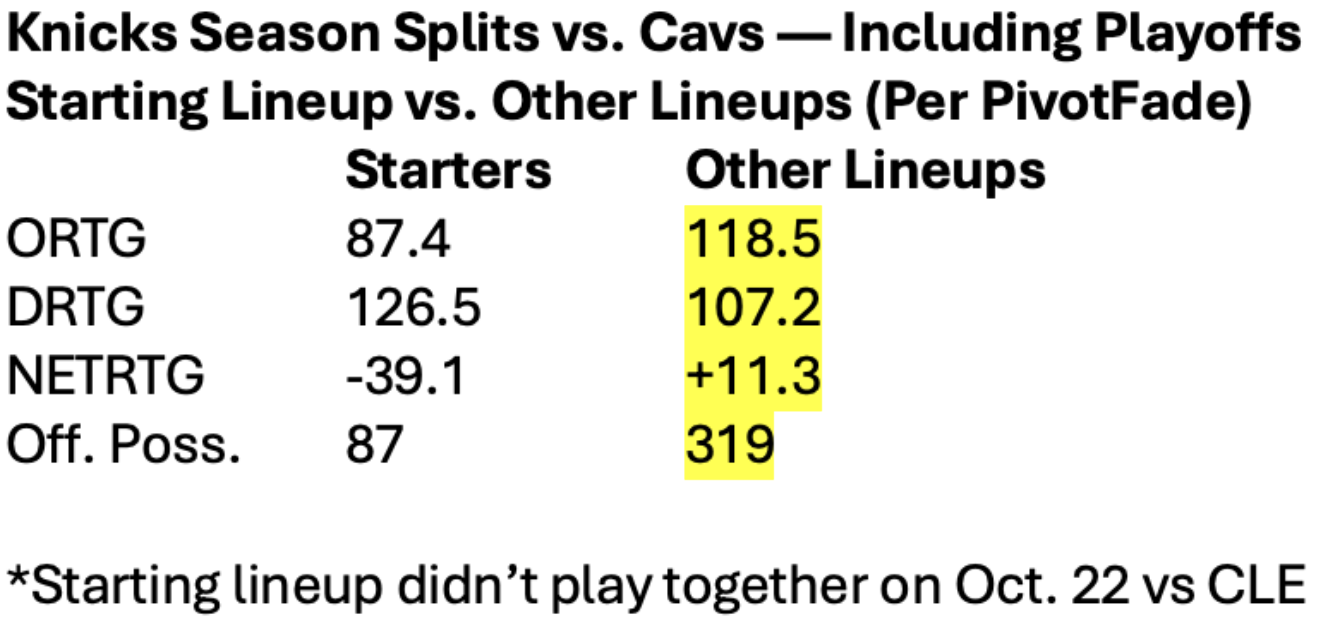
As our very own Shwin alluded to on Twitter, the Knicks’ starting lineup has gotten run out of the gym against the Cavs this season. In 87 offensive possessions together, they have an 87.4 ORTG, 126.5 DRTG, and -39.1 NETRTG. In 319 offensive possessions of any other type of lineup combo, the Knicks have a 118.5 ORTG, 107.2 DRTG, and +11.3 NETRTG against the Cavs — and that includes the season opener where Hart wasn’t active.
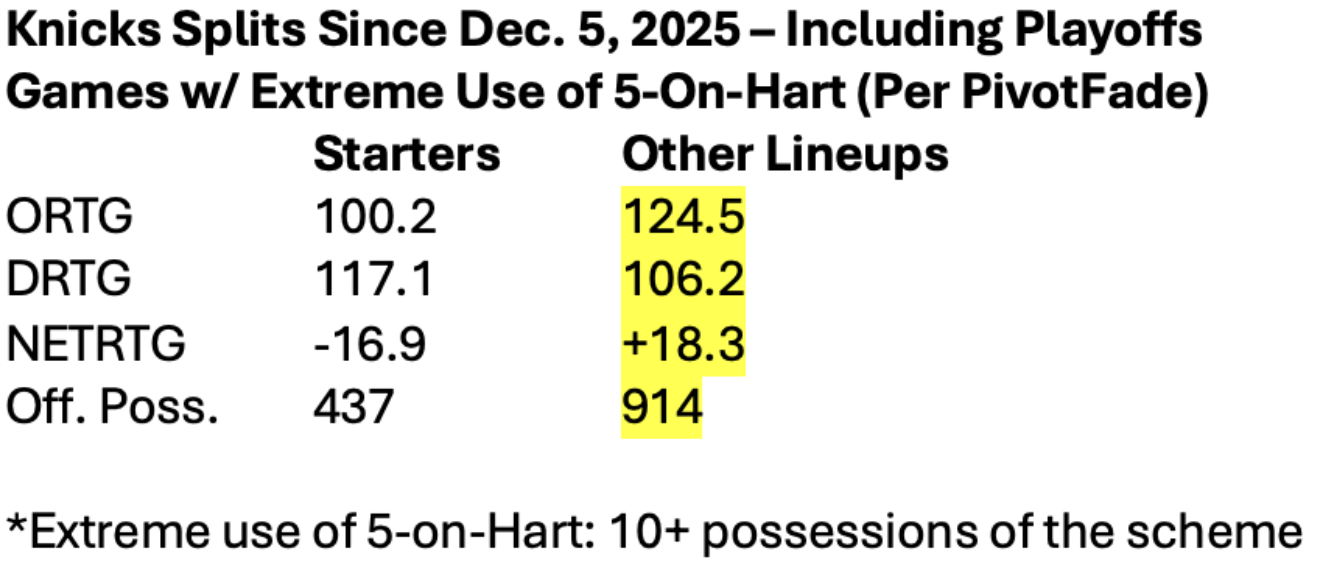
Since the Knicks officially went back to last season’s starting lineup this season on Dec. 5, that five-man lineup struggled in games where the opposing team has decided to guard Hart with their center for at least 10 possessions.
For clerical purposes, I usually use ShaxNBA’s tracking sheet for this, but I’ll safely assume the Cavs employed heavy ghost coverage against Hart before he uploads his tracking for Game 1.
In those games, the starters have a 100.2 ORTG, 117.1 DRTG, and -16.9 NETRTG in 437 offensive possessions. However, in the 914 offensive possessions in those games where any other five-man lineup combination was on the floor, the Knicks had a 124.5 ORTG, 106.2 DRTG, and +18.3 NETRTG.
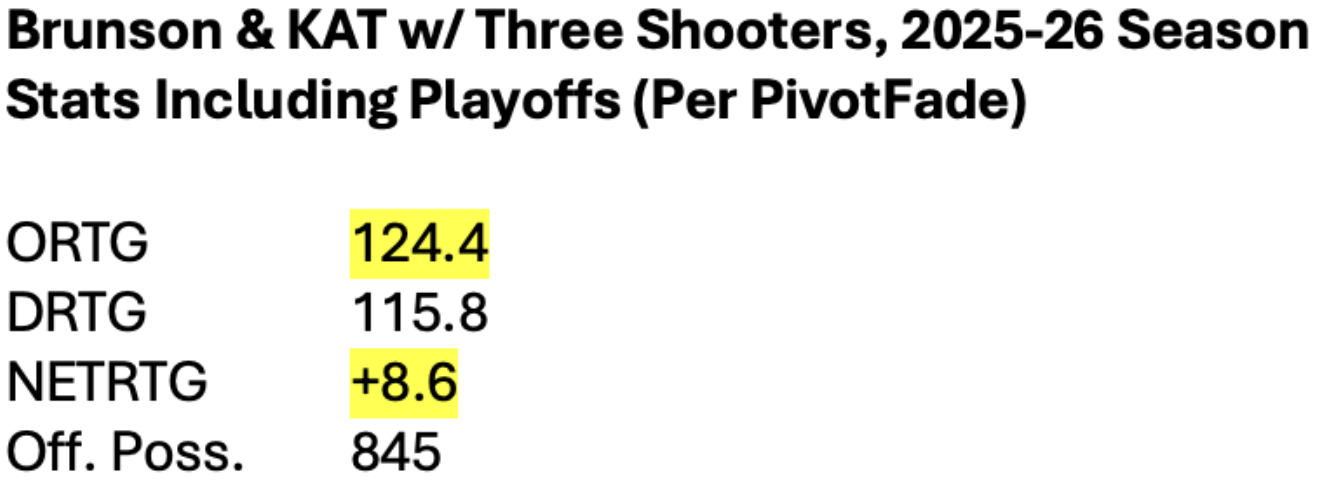
As Geoff Rasmussen of Hot Hand Theory mentioned — and his co-host XJ has banged this drum for most of the last two seasons — the Knicks’ offense just works better when they surround Brunson and Towns with three other shooters. Including the playoffs, the Knicks have a 124.4 ORTG and +8.6 NETRTG this season when they employ five-out lineups with Brunson and KAT.
To sum up everything, the Knicks’ comeback win makes sense from a wide scope when you realize that Brown has done an excellent job this season when it comes to pulling the plug on the starters and pushing the right buttons with other lineups. However, in no way does that take away from how truly historic that comeback was.
The Knicks were down 22 points with seven minutes and 40 seconds left in the fourth quarter. The only team in the play-by-play era (since 1996-97) to have a larger fourth quarter comeback in the playoffs was the Clippers in Memphis in 2012 (24 points).
Brown has ample data to pull from to realize what works, what could work, and what probably won’t work against this Cavs team. They won the series opener against the Cavs without Hart. They had that amazing comeback against them on Christmas Day by relying on other lineups. And they won Game 1 by changing up things once again.