

Knicks fandom, the philosophical way
In a world dominated by short attention spans, are sports one of our last bastions of shared interest communities?
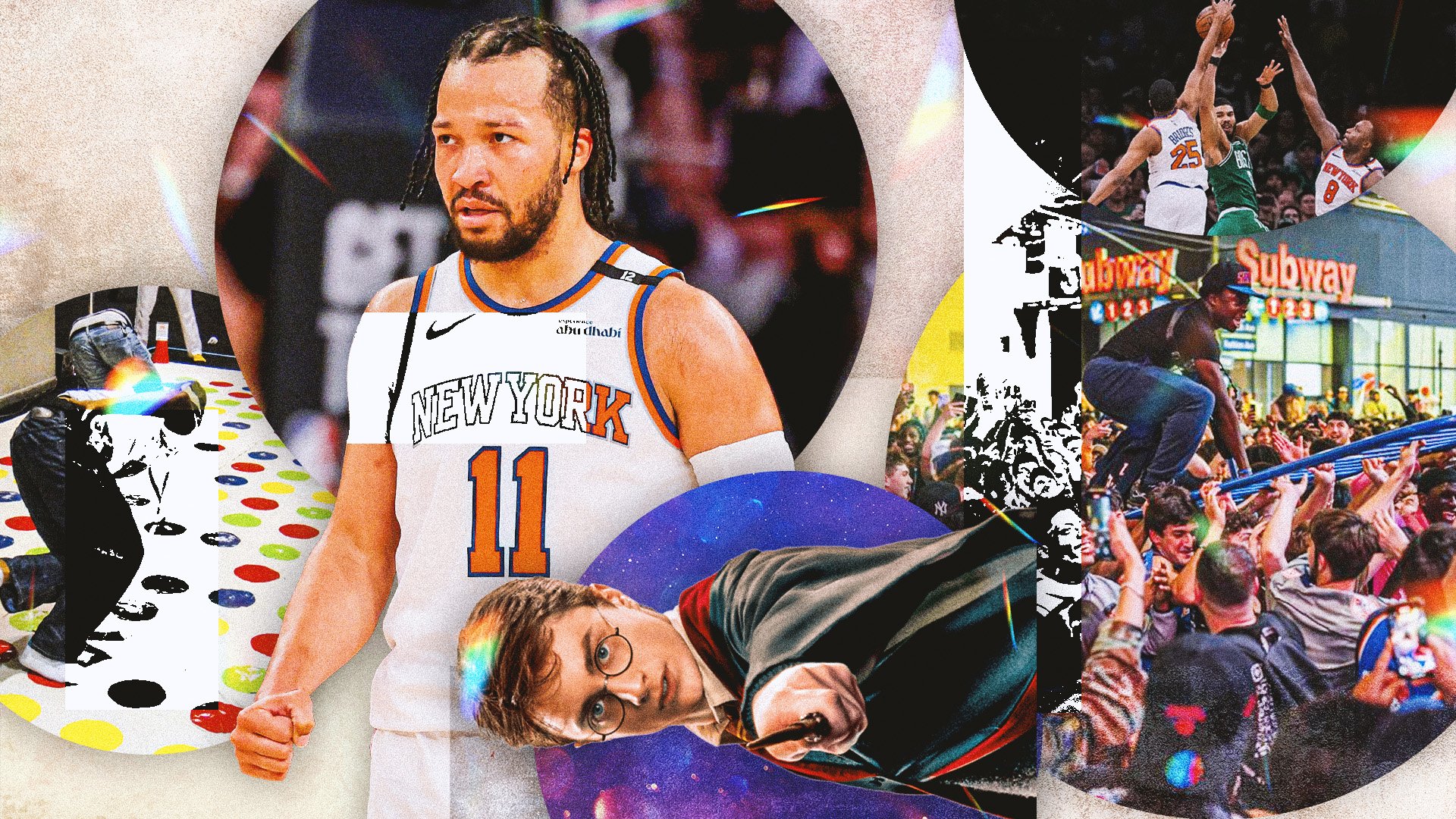
When I was a kid, Harry Potter was wildly popular. I had friends who stood in long swerving lines at Barnes & Noble all night just so they could be the first to lay eyes on its magical chapters. Even my little league baseball team in West Virginia, not a group of kids particularly prone to caring about wizards, was talking about the books. Everywhere I ran into other kids, they were gossiping about who they hated (Snape), fan theories about the downfall of evil characters (especially Snape), and getting excited about made-up sporting competitions (Quidditch).
Perhaps my memories of this are especially vivid, because I watched most of it from the sidelines. I was one of those kids who wasn’t allowed to read or watch Harry Potter (in fact, I was not even allowed to hang out with my crush because they had read Harry Potter).
As soon as I reached adulthood, I reached for the series. I wanted to know what I had missed out on, what had driven my friends to wait (before smartphones) in long boring lines half the night. What I found was a lot of disappointment. Sure, the books were alright. There’s a decent story there. But there are lots of much better stories. What was obviously missing from my experience in a lonely Ohio apartment was the joy and excitement of sharing the story with other people.
There was an era where works that captured the culture's imagination came along every so frequently. Sometimes they were movies (Star Wars, Titanic, Lord of the Rings), sometimes they were television shows (The Sopranos, Breaking Bad, Game of Thrones), sometimes they were books (Harry Potter, The Hunger Games, Twilight, Fifty Shades of Grey). But you could always be sure that some piece of art would come along and make the water cooler, awkward chats with strangers, and bar trivia with your buddies particularly enjoyable for a few weeks (I’ve spent days of my life wishing on Lord Baelish’s downfall with people I had just met, weeks wondering where WAS Gondor when the Westfold Fell with my drinking buddies, and months (years?) quoting every line of The Sopranos back and forth with close friends).
Many of these were incredible works of art (I will go to my grave believing The Sopranos is the greatest work of American Existentialism). Some of them were just okay. Some of them started out great, but fell apart at the end. But their magic was not primarily in their quality as works of art, but in their power to bring people together.
It seems to me that this phenomenon has become less common. It feels like it’s been some time since the last piece of long-form art really captured the imagination of the culture in the way these works did. I’m not exactly sure why that is. Maybe less great art is being made, as media companies start targeting content suitable for watching while scrolling. As Will Tavlin puts it:
[...] slipshod filmmaking works for the streaming model, since audiences at home are often barely paying attention. Several screenwriters who’ve worked for [Netflix] told me a common note from company executives is “have this character announce what they’re doing so that viewers who have this program on in the background can follow along.” (“We spent a day together,” Lohan tells her lover, James, in Irish Wish. “I admit it was a beautiful day filled with dramatic vistas and romantic rain, but that doesn’t give you the right to question my life choices. Tomorrow I’m marrying Paul Kennedy.” “Fine,” he responds. “That will be the last you see of me because after this job is over I’m off to Bolivia to photograph an endangered tree lizard.”)
Or perhaps because recommendation algorithms increasingly personalize the content we consume to our unique interests (or at least to what will keep us watching), we’re consuming less of the same media. Or maybe I’m just missing out on what’s popular as I get older.
Whatever the explanation, one place where this magic still seems alive is in sports. Week after week, millions of strangers tune in to watch Jalen Brunson lead his team onto the hardwood to write a story.
Sometimes these stories are awesome. May 5, 2025. The Knicks are the overwhelming underdogs against the mighty Celtics. It’s Game 1 in the small ‘g’ Boston garden. The Knicks are feisty early, but by the middle of the third quarter the Celtics have secured a commanding 20-point lead. Things look like they’re about to go as expected. But then the unthinkable happens. OG Anunoby hits two threes, sparking a run that culminates with the Knicks retaking the lead off a vintage Brunson step-back three over the helpless arms and shaky legs of Al Horford. After a wild exchange of body blows between Tatum and Brunson, Mikal Bridges sealed a glorious Game 1 victory with a steal. I called or texted every Knicks fan and every Celtics fan that I had contact information for that night.
Sometimes the stories are repetitive and not very good. From 2014-2020 the Knicks’ showrunners fell in love with the fake comeback. The Knicks, filled with castoffs, bad trades, and poor draft choices would trot out onto the court and immediately get overwhelmed by better teams. But as the game wore on and victory seemed sure for the better team, the Knicks would get a spark. A transition dunk, a defensive stop, a three, and suddenly the Knicks were within striking distance. Inevitably, their opponents would awaken from their stupor and put to bed our brief glimmer of hope.
During the fake-comeback era, I was spending a lot of time in the comment section of a Knicks blog. Indisputably, the stories the Knicks were writing were bad. The team was bad and lacked direction. There were very few standout performances. The offensive schemes were often uncreative or written for the wrong era (hi, Jeff Hornacek). And yet, as soon as the Knicks strung together a couple stops and buckets and cut the lead to single digits in the fourth quarter, the message board would light up with people saying “Fake Comeback,” "MAYBE THIS IS THE TIME IT HAPPENS,” “So you’re saying there’s a chance.” There was real joy and camaraderie in watching that lazy and regurgitated narrative.
Allow me to take you down a philosophical tangent.
C. Thi Nguyen is a philosopher at the University of Utah who works on the philosophy of art and games. He’s recently been writing and speaking about what he calls “value capture.” Here’s how he puts it:
“Value capture happens when
1. Your values are rich and subtle [...].
2. You enter some social (typically institutional) setting that offers you simplified, often quantified renditions of your values.
3. The simplified versions take over.”
Here’s an example. Imagine a person, let’s call them “McLikey,” who gets their start in basketball journalism in 2005. McLikey decided this was the field for them because they love the sport. They’ve always been fascinated by in-game strategy, they find immense beauty in the game and the story of the game, and basketball played a significant role in their relationships with their mother and brother (they all loved the Knicks!). When McLikey decides that this is the career for them it is with the goal of sharing what they find interesting and beautiful and meaningful and joyful about the game with others. And early in McLikey’s career, their writing does all of these things, and does it well.
Fast forward a year: McLikey’s boss sends them a memo about a new platform that she wants them to start sharing their articles on, “Twitter.” McLikey is psyched! It’s a place where there’s already a community of people talking about the game, and it provides them with an opportunity to share their love of the game with even more people. As McLikey starts uploading their articles and tweeting their thoughts, they get extremely excited about getting likes and shares. They’re just thrilled that people are interested in their work. However, as time passes, McLikey starts to focus more on the reaction they receive, than on the substance of the articles they write. For a while McLikey thinks, “if I just get a big enough following, I’ll start writing more of the stories I care about.” But as the years pass, McLikey’s focus ceases to be on the strategy, the human interest element, the community, and the beauty of the game. Instead, they are increasingly motivated to tweet and write whatever they think will earn them the most clicks.
As Nguyen would put it, McLikey’s values have been captured. They had subtle and rich reasons why they cared about basketball, and subtle and rich goals for why they wanted to write. Slowly but surely, however, those rich and subtle goals were replaced by the simple and seductive goal of getting more likes and shares.
McLikey is not an unusual case, and this is not a phenomenon that’s confined to sports journalism. Most of us know someone who started off tracking their steps or their BMI in order to improve their health, but has gotten so obsessed with these metrics that it has become unhealthy. Most of us know someone who went to college with a desire to learn, but became so focused on getting As that they learned much less than they would have if their focus had been different. Most of us know NBA players who started playing outside the spirit of the game, in order to gain a competitive advantage. In a world filled with metrics meant to guide us and evaluate us, it is all too easy to start striving to do well according to the metrics while losing sight of what is really important and what we really care about.
Consider one final example that Nguyen gives. Imagine that you and your friends are all playing Twister. It’s silly, it’s a little awkward, everyone laughs and has a good time. Well, almost everyone. Imagine that one of your friends loses and gets inconsolably upset. They’re pissed off! They start complaining that the game was unfair, they demand a rematch, they throw the spinner across the room and storm out. Obviously, something has gone seriously wrong here.
For Twister to be fun, we all have to buy into the metrics that are built into the game a little bit. If we treated winning as silly as it is, none of us would contort ourselves or embarrass ourselves sufficiently for it to bring about the joy it often does. But, of course, the point of a game like Twister — the whole reason we play — is to have fun with our friends, to build community, to be a little bit silly. The point is ultimately not to win. What has happened to our friend is that they have gotten so focused on the stated objective of the game, that they’ve missed the true deeper point of the game.
I’ve written before about a funny thing that happens when NBA teams get good. Their fans become correspondingly more miserable. The joy they used to share seems to drift away under the weight of expectations. I think Nguyen’s idea can help us understand why this happens. The obvious goal of the game of NBA basketball is to win championships. The entire league, from players to presidents of basketball operations, take on this goal. Here, for example, is Steve Ballmer excitedly sharing Kawhi’s view that “it’s all about the Larry O’B.”
But while teams and players adopt this goal, it is clear that this isn’t all that matters to fans. Why do fans get annoyed by foul-baiting, even when their own team does it? Because “it’s not in the spirit of the game.” Why do fans get bothered by tanking, even when it’s in the best interest of their team? Because it’s not in the spirit of competition. Why have fans and commentators been so worried about teams that shoot too many threes? One reason James Marceda offered is that fans want maximum fun, and one thing that is fun is seeing the ball go in the hoop. As teams take more and more threes (shots they’re destined to miss more than layups and dunks), basketball becomes less fun to watch. Similarly, some like Ben Taylor and Shane Battier worry that NBA rule changes surrounding the gather step and legal guarding position are making basketball less awesome and less aesthetically pleasing.
More generally, there are a multitude of reasons why people care about basketball. For some it really is art (and it’s hard to argue with them when you see the majesty of Steph Curry). For some it’s just fun entertainment. For some, it is a way of keeping connected to a city that they’ve moved away from, or of getting to know a city they just moved to. For many of us, the community benefits play a major role in why we care. Basketball keeps us in contact with old friends — I have an excuse to text my Miami Heat fan friends every time the Knicks play them. Basketball helps us make new friends and gives us something to talk about in line at the coffee shop. Basketball is a topic that’s safe to talk about with relatives who you have strained relationships with. Basketball, much like great works of fiction, gives us an opportunity to come together as a city, as a fandom, even as a country.
I think that in order to fully get some of these goods — to appreciate the artistry, to really have fun, and to connect with others — we probably have to take the goal of NBA basketball a little bit seriously. We have to want our team to win the championship. If we treat it as a joke, if we don’t want our teams to win, we won’t be invested enough to feel the elation of Brunson’s step-back three over Horford. And if we don’t take it seriously enough, we will likely miss out on many of the community aspects. It is only because we hated Joffrey and Petyr Baelish deep in our hearts, that we were motivated to talk so frequently with our friends about them. In this way, basketball fandom is like Twister. To get the goods of Twister, we have to buy into the game to a degree.
But there is a tightrope we must walk. When we start caring too much about our team winning the championship — when this becomes the only reason we watch and the metric by which we evaluate our own success as a fan — we risk becoming like our friend who threw the Twister spinner. Every year 30 teams compete in a competition that only one can win. When being a fan becomes “all about the Larry O’B.,” we are destined to have a bad time most years. And no one wants to hang out with the guy that throws a tantrum playing Twister.
More than this, it is important to notice that one’s team winning the Larry O’B. will not alter what really matters in our lives. When the Knicks (hopefully) win a championship again, this will not be something that people will count to my credit when I die. To do so would be like congratulating a person whose favorite television show wins an Emmy. Good for me for sitting on the couch and watching, I guess? What we get credit for are projects that we invest in, take part in, actually contribute to making come to fruition, and in so doing make a positive difference to other people’s lives. At least, this is what the philosopher Susan Wolf argues. Building a community around basketball can be one of these projects. But when we lose sight of why basketball is worth caring about and make our team’s winning the chip the primary goal of being a fan, we become like McLikey. Our values get captured.
In my view, fans of good teams are more susceptible to having their values captured in this way. When teams are bad, it is easy to not take the goal of winning too seriously. Winning can feel so, so far away — a fantasy! In this context, it is easy to focus on community, to look for good stories, and to invest only enough to make it enjoyable. But, when fantasy transforms into a reasonable possibility, it becomes much harder to maintain this healthy distance. For fans of teams with high expectations, it is difficult to lose sight of the fact that being an NBA fan is ultimately just a magical game of Twister. The real magic is not primarily in the quality of the NBA stories nor in the winning of Larry O’B.s, but in its power to bring people together.