

The time for experimenting is over.

A lot of fuss has been made through two playoff games of Mike Brown’s usage of lineups and the way he’s managed rotations. All season long, he’s been a major perpetrator of tinkering and experimenting — but it’s the postseason now, and the need for that is long gone.
One of the major things that Brown, and his predecessor Tom Thibodeau, have been criticized for over the last two seasons is the blind reliance on the starting five-man group of Jalen Brunson, Mikal Bridges, Josh Hart, OG Anunoby, and Karl-Anthony Towns.
That five-man lineup has had a 118.0 offensive rating (ORTG), 117.3 defensive rating (DRTG), and +0.7 net rating (NETRTG) in over 1,200 possessions this season, including early-season minutes where they weren’t the starting lineup, the NBA Cup Final vs. the Spurs, and the playoffs vs. the Hawks.
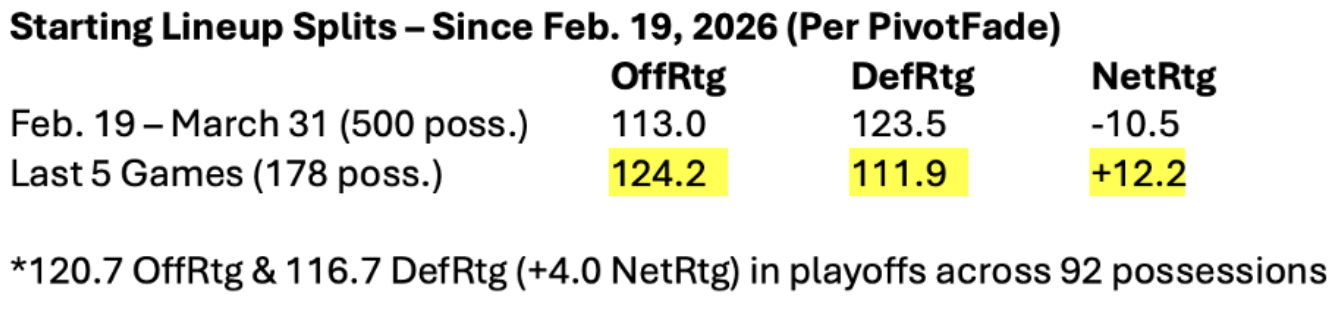
Despite those overall numbers, it does seem that Brown has found a way lately of making that five-man lineup work. The starting lineup over their last five games together (178 possessions) has a 124.2 ORTG, 111.9 DRTG, and +12.2 NETRTG — all games coming against the Hawks (three games), Celtics, and Raptors.
Specifically against Atlanta in the playoffs, the starters have a 120.7 ORTG, 116.7 DRTG, and +4 NETRTG across 92 possessions together. Keep in mind: the starters got pelted across 500 offensive possessions from Feb. 19 through March 31, before that five-game stretch. They posted a 113.0 ORTG, 123.5 DRTG, and -10.5 NETRTG during that span.
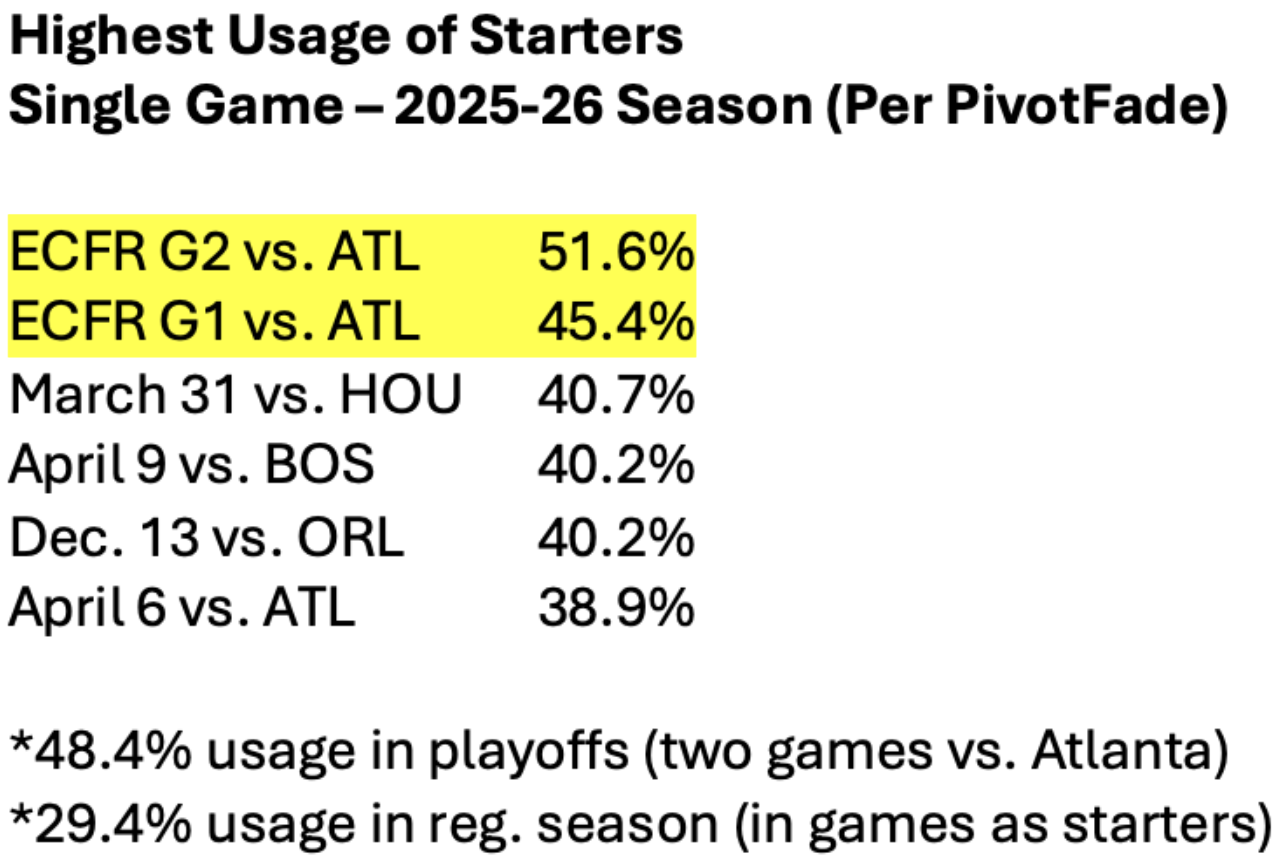
That’s 48.4% of the Knicks’ possessions on offense. Starters were only used in 29.4% (1,043 of 3,548 offensive possessions) during the regular season — excluding games where the lineup wasn’t the starting lineup. Prior to the playoffs, they didn’t have a single game where they used the starters more than 41% of the time.
Brown has heavily leaned on the starters. Actually, that 45.4% usage mark in Game 1 would’ve been even higher had Anunoby not tweaked his ankle, as the Knicks were on pace for 57.1% usage after being used for 28 of 49 first-half possessions in that game.
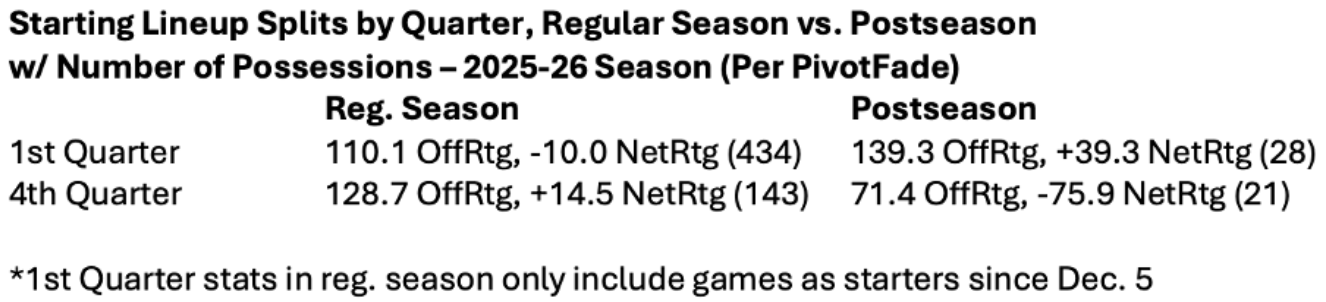
The starting lineup has dominated the Hawks through the first three quarters of games in this series, posting a 135.2 ORTG, 108.5 DRTG, and +26.8 NETRTG across 71 possessions, which is a hilarious thing to consider since the starters had a 110.1 ORTG and -10 NETRTG in the first quarter alone during the regular season (434 possessions) following them once again becoming the starting lineup on Dec. 5. In the playoffs, they have a 139.3 ORTG and +39.3 NETRTG in 28 first-quarter possessions — much different than the regular season.
However, the starting lineup has gotten run off the floor this series in the fourth quarter with a 71.4 ORTG, 147.4 DRTG, and -75.9 NETRTG (21 possessions). That’s crazy to think about since the starters had a 128.7 ORTG and +14.5 NETRTG in 143 possessions in the fourth quarter — including early games they didn’t start together — in the regular season.
It’s important to remember: the Knicks had an NBA-best +12.5 NETRTG in the fourth quarter during the regular season. In the postseason so far, their -23.9 NETRTG in the fourth is the worst mark among all 16 playoff teams.
So that moves to the rotations conversation part of our programming. Before we get to the crazy second quarter and fourth quarter lineups, it’s important to touch on what Brown has decided to do with the double-big lineups with KAT and Mitchell Robinson.
During the regular season, 371 of 550 (67.5%) of the KAT/Mitch lineups were without Hart. In those minutes, the Knicks had a 122.6 ORTG, 108.1 DRTG, and +14.5 NETRTG. In the other 179 possessions where Hart was on the floor with that duo, the Knicks had a 103.4 ORTG, 117.2 DRTG, and -13.9 NETRTG.
In the playoffs, all 11 of the double-big lineup offensive possessions have come with Hart on the floor. To the shock of nobody, the lineup has struggled to a 100 ORTG, 136.4 DRTG, and -36.4 NETRTG in those minutes.

For virtually all of the regular season, the Knicks employed a pretty strict staggering of their two stars. Brunson would usually play the entire first quarter, while Towns would get subbed out after 6-8 minutes so that he could start the second quarter with the bench — typically getting paired with one of the starting wings in those minutes.
In the final week of the regular season, something changed for Brown. He’s now opted to start the second and fourth quarters with neither of his stars on the floor... and that began on April 6 in the final regular season meeting between the Knicks and Hawks.
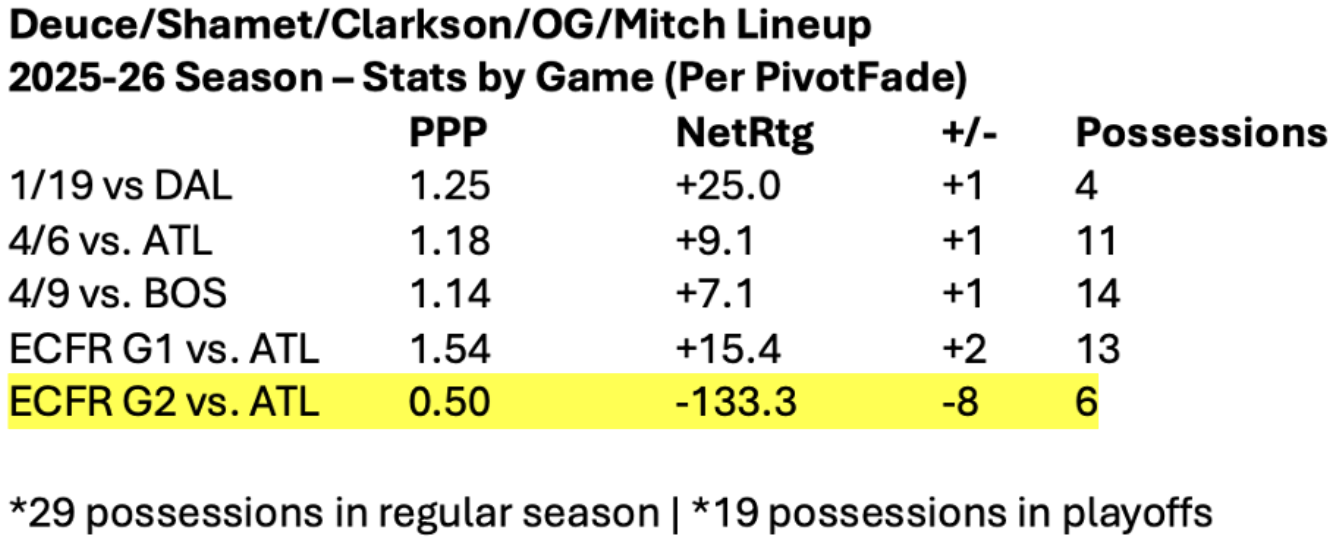
After only being used together for a total of four possessions in a blowout loss to Dallas in January, the five-man lineup of Deuce McBride, Landry Shamet, Jordan Clarkson, Anunoby, and Robinson has played together in four games in April — including 19 possessions in the playoffs. They only had 29 possessions together in the regular season.
For this five-man lineup, the data has been all over the place... that’s what you get with such a small sample. They won their minutes in every game except Game 2 vs. Atlanta, but they were terrible in their miniscule six-possession stretch together, getting outscored by eight points and only scoring three (0.50 points per possession).
Brown chose to go to Jose Alvarado in the second quarter for two possessions (three on defense) for a spark when it became obviously glaring to anyone watching that the Deuce/Shamet/Clarkson/OG/Mitch lineup didn’t have it. He then went back to Alvarado to start the fourth quarter for four minutes (six possessions) to hold the line. Without Alvarado, there’s no above-average ball-handler on the floor… because McBride has shown over the years he’s not a point guard, Shamet is more of a spacing shooter than a guy who can handle the rock, and Clarkson doesn’t have the quickness to do much.
"We've played that lineup quite a bit, since the end of the season,” Brown said of his Towns-and-Brunson-less lineup in his remarks after the Knicks’ Game 2 loss. “That lineup's been pretty good. We weren't good tonight, and we turned the ball over a few too many times during that period. But we had opportunities where our starters were in, and we were up 8 to 10, and Atlanta closed it.”
The Knicks haven’t been great overall with both Brunson and Towns on the floor together through two games in the playoffs, but that goes back to the double-big lineup stuff... because Brunson was the point guard for those minutes, clogging things up with a five-man lineup of Brunson/Bridges/Hart/KAT/Mitch. However, the Knicks need at least one of their stars on the floor at all times in the playoffs where every game is a must-win — that’s not negotiable.
The Knicks have an +8.3 NETRTG with at least one of Brunson or KAT on the floor during the playoffs, according to Cleaning the Glass. However, they’ve had more possessions without either of them on the floor (35) than with just one of them on the floor (30) this postseason.
In the minutes where they have just one of Brunson or KAT on the floor, the Knicks have a 130.0 ORTG, 76.7 DRTG, and +53.3 NETRTG across 30 possessions. In the 35 possessions where both players have been off the floor, the Knicks have a 114.3 ORTG, 124.3 DRTG, and -10 NETRTG. If you’re doing the math, that’s a 63.3-point swing!
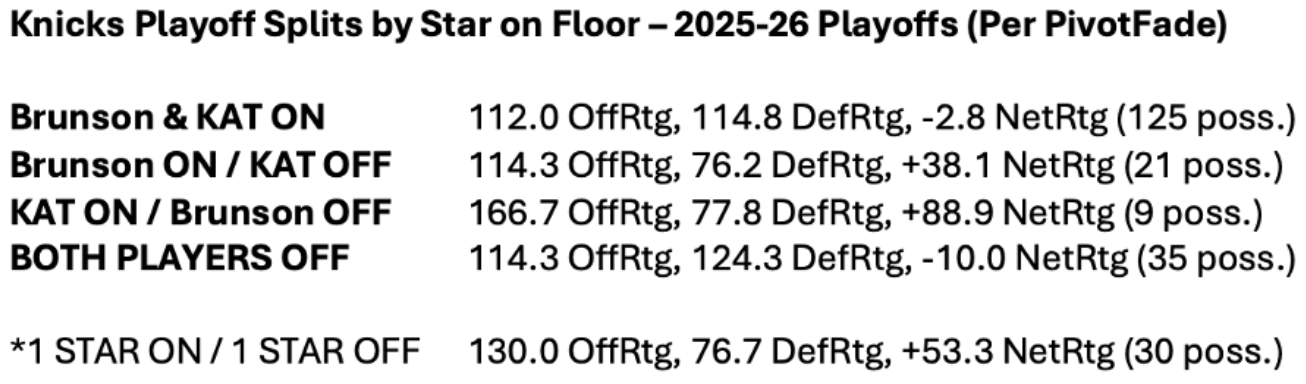
That 166.7 ORTG in the KAT minutes without Brunson is astonishing, but it’s also small sample size noise... because it’s only NINE possessions.
During the regular season, 39.6% of the possessions when both played in the second and fourth quarters (not including garbage time) were with KAT on the floor without Brunson. That number is down all the way to 6.4% in the playoffs... with Brown either opting for both or neither on the floor.
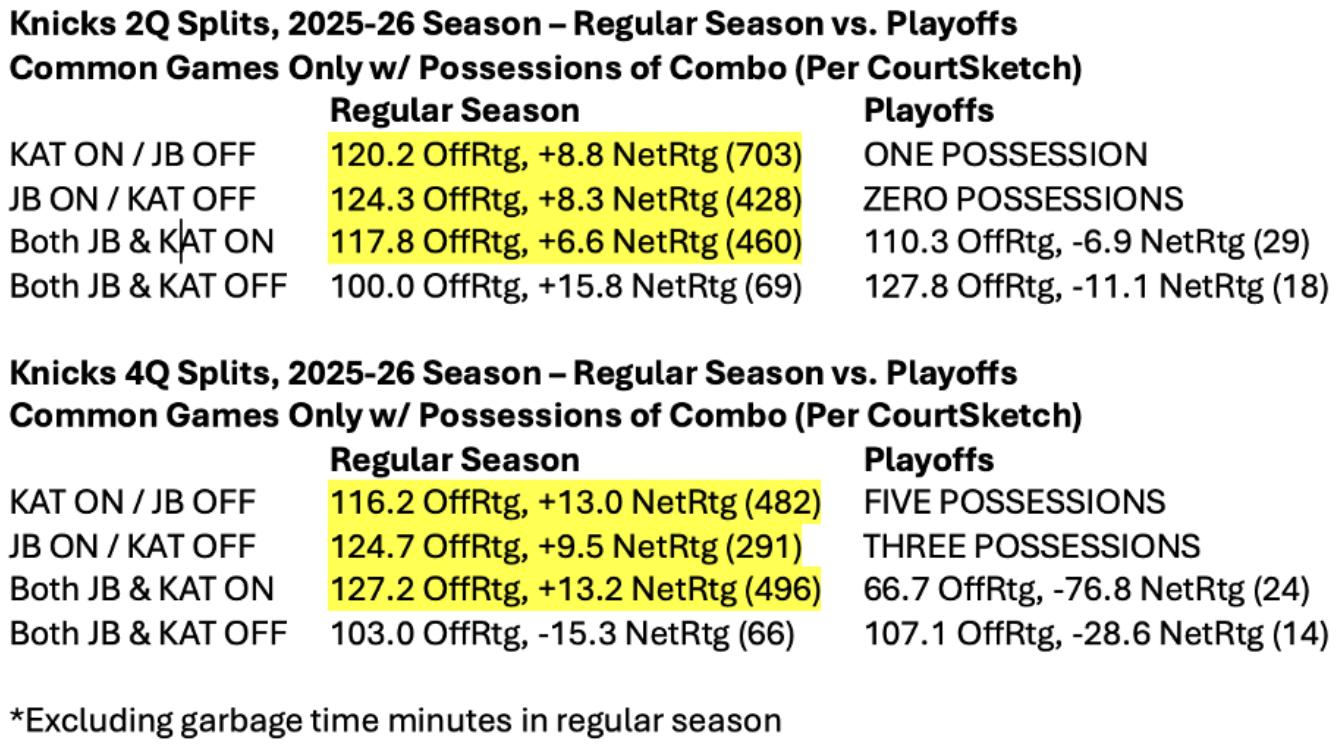
After reading through almost 1,200 words, I think everyone has the gist of what’s going on. The starters have been really good to start games, but they’ve struggled down the stretch, and a lot of that can probably be attributed to Brown’s rotations being unrecognizable.
All season long, Brown was a mastermind at finding lineups that clicked well together when the starting lineup didn’t have it — and for most of the team’s play after New Year’s, that was what was needed. There was always a caveat, though: one of their starters had to be on the floor or things would stall.
It’s the postseason and we’re around six months into watching the Knicks this season. We as fans know what works and the coaching staff knows what works. It’s great that Brown has found ways to maximize the starting lineup late in the season after so many months of people clamoring for change. But after his worst coaching performance since taking over at the helm for the Knicks, he should go back to basics with the rotations.